
Back in November, I was invited by Member of the European Parliament (MEP) Carola Rackete to travel to Sweden as part of her Seeds of Action tour. Carola is part of the Left Party in the European Parliament and is perhaps best known for an incident where she rescued asylum seekers in the Mediterranean Sea in 2019.
She docked without authorisation in Lampedusa, Italy, to save the lives of the asylum seekers onboard and was arrested by the authorities. As a result she faced up to 15 years in prison. Eventually, the Italian Supreme Court of Cassation ruled that she should never have been arrested.
Following her actions she was given many awards for her bravery and humanitarian work. She later ran for office as a MEP for the Left Party and was elected in July 2024.
As part of her role she is conducting a tour around the world visiting groups who are campaigning around the climate and ecological crisis. In the UK, she visited Lucia Whittaker De Abreu, a climate activist imprisoned for 4 years for her role in organising the M25 blockades with Just Stop Oil.
From there she was travelling to Sweden. On each leg of the journey she has funding to take someone from the previous country to the next country to meet other climate campaigners, share their experiences and learn from each other.
Travel to Sweden
I was privileged enough to join Carola on the train to Sweden. The journey, naturally, was going to be taken by train being the most environmentally friendly way to travel that distance. I hopped on the Eurostar from London St Pancras International to Brussels, then onwards to Cologne where I stayed the night.
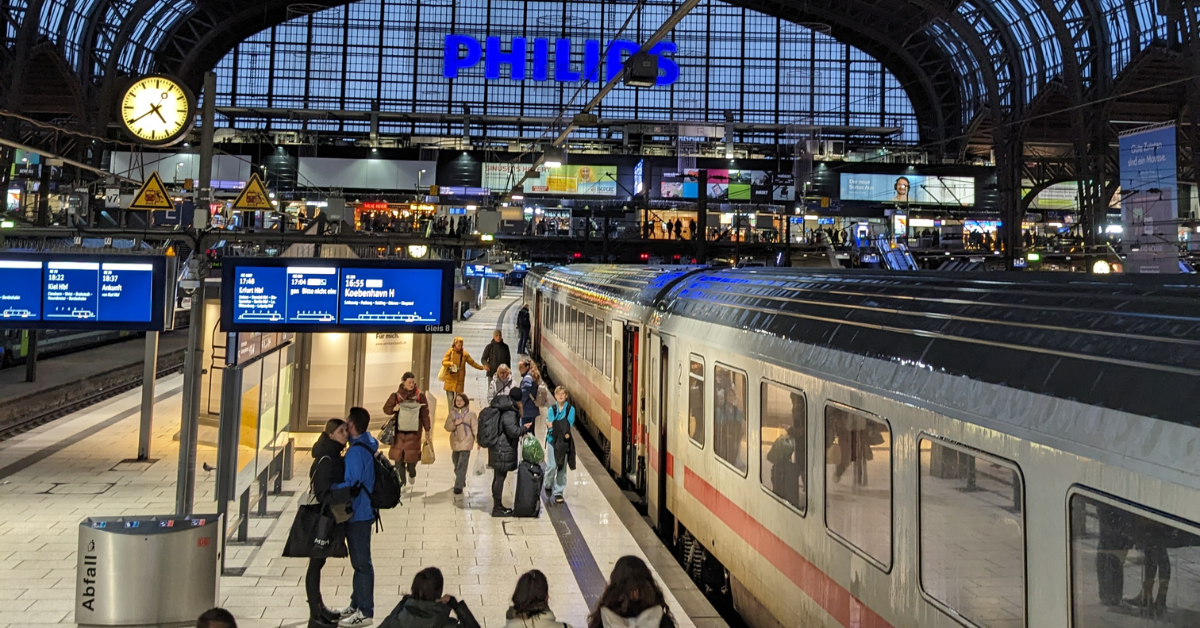
The following day I got the Deutschebahn to Hamburg where I met Carola and her assistant Isabel. We shared a cabin up to Copenhagen and finally across to Malmö, Sweden. Carola is a fascinating person to talk to and she was really interested to hear about our work in Safe Landing, particularly around Workers’ Assemblies.
In Malmö the next day, we met a group of young climate campaigners who have been working, amongst other things, to tackle the massive climate impact of the oil port in Malmö. In the evening, I spoke at a roundtable discussion about our work in Safe Landing and heard about their experiences of campaigning in Sweden and the wider European context.
As young campaigners they’re facing similar repression on their rights to protest as campaigners in the UK did 4 years ago as a result of government laws. They’re concerned that the UK has set a precedent for draconian anti-protest and anti-trade union laws that will spread throughout Europe with the rise of far-right governments.
That being said, they were buoyed to hear about our work around Workers’ Assemblies with the British Airline Pilots’ Association (BALPA) and our Bristol workshop in 2023. Carola also talked about the amazing work of German group Wir Fahren Zusammen uniting climate campaigners and bus drivers.
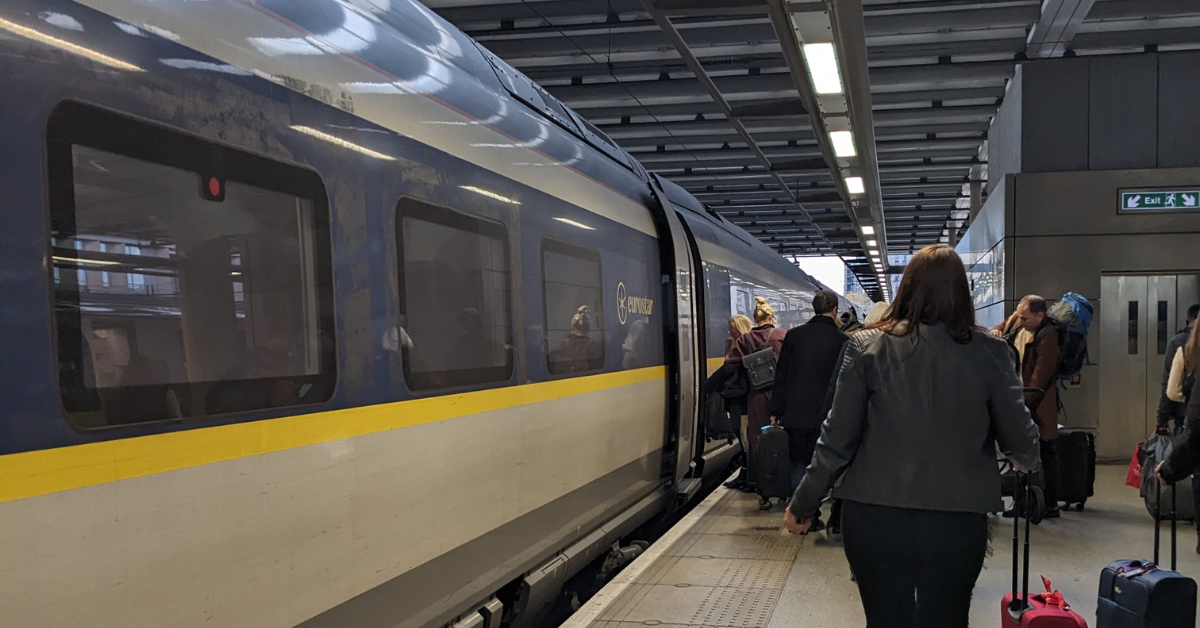
My stay in Malmö was short but sweet and I boarded the train back to London the next day, again via Hamburg with an overnight stay in Cologne.
Some observations I made about travelling to Sweden by train were:
- It is incredibly expensive. My train travel cost around 700 EUR. A flight from London Stansted to Copenhagen costs as little as 28 GBP with RyanAir. All you need to do then is take a fairly cheap and short train to Malmö.
- It is a long journey – 2 days travelling there, 2 days travelling back. A flight would have taken only 1h45 with a short 40 minute train journey at the other end.
- Despite the long journey, it was much less tiring than a flight of the same length. I didn’t get the characteristic swollen feet and dehydration that you get when flying. I was able to connect to Wifi and do a day’s work on the train, whilst looking at the view out of the window.
- Much like mine and Todd’s drive to Italy in October, the train journey allowed me to get a real sense of distance travelled to get to Sweden. I was able to observe the change in landscape, culture and accents along the way.
- Having to stay overnight in Cologne and changing trains at Brussels and Hamburg allowed me to spend some time exploring more cities as part of the journey.
Even though the journey was very enjoyable, to make it accessible to the average person wanting to take the train instead of flying we need to do a number of things.
We need to make trains far cheaper to compete with plane journeys. To do this we can implement something like a fuel tax and a frequent flyer levy to raise the money to subsidise rail travel.
We need to allow people to have more time off work to allow for the lengthier train journeys. Employee benefits schemes like Climate Perks allow member organisations to break down a key barrier to clean travel by offering their staff the opportunity to take additional days off work – usually 2 per year – if they use clean travel options (train, ferry etc.) instead of flying when they go on holiday. Schemes like this need to become mainstream and rolled out by national governments.
The aviation worker perspective
I know what you may be thinking – won’t making flights more expensive be bad news for aviation workers and jobs?
Contrary to popular belief, increasing plane ticket prices doesn’t necessarily have to negatively impact workers and their job prospects. Not only is it necessary to raise the funds needed for research and development into future lower carbon technologies, it is also necessary to address demand for flying and absolute emissions of aviation in the short-term.
This will futureproof jobs for aviation workers in the face of national legally-binding targets to reach net zero. If we don’t reach those targets, our industry will face being legislated out of existence creating widespread permanent redundancies.
More than anything, though, we need aviation workers to be empowered to make their own decisions about how our industry addresses the climate crisis and this opportunity to transform our industry for the benefit of all.
One of the ways we can do this is by carrying out deliberative democratic processes like Workers’ Assemblies in our unions. Safe Landing’s goal is for national governments to commission a sector-wide Aviation Workers’ Assembly.
Workers must have a say in how our industry transforms in the coming crucial years.
If you want to discuss Workers’ Assemblies and potentially enacting one in your union, email me:
george@safe-landing.org
Author: George Hibberd
Safe Landing Trade Union & Workers’ Assembly Lead
Former Airline Pilot