

👩✈️ Safe Landing were quoted in this article in the Guardian (UK) and in this article in Euronews (EU) about a ‘Frequent Flying Levy” in Europe that could cut aviation emissions by a fifth.
 👨✈️ “We love flying and the planet but our freedom to continue flying in the future is now under threat,” said Finlay Asher, an aerospace engineer and cofounder of Safe Landing, a campaign group made up of aviation workers pushing the industry to act in line with climate science. “It will be impossible to set ourselves on a new trajectory of rapid emissions cuts without focusing on frequent flyers, who are responsible for the majority of our pollution.”

📉 The articles highlighted a recent study from the New Economics Foundation (NEF) and partners, which modelled the climate effects of a staggered tax on flights and found the proposal would reduce passenger numbers in 2028 by 26% and emissions by 21% vs. a ‘business-as-usual’ scenario.

🧳 They found that just over half (54%) the savings in a given year would come from the 5% of people who fly the most, while 72% of people would escape fees by flying either once only or not at all.
 💰 Globally, 1% of the world’s population produces 50% of aviation emissions, while approximately 80% have never set foot on a plane. Within western Europe, NEF’s analysis shows that the highest-income households (over £/€100,000 per year) are at least six times more likely to take three or more return flights per year than those on the lowest incomes (under £/€20,000 per year). Meanwhile, among the lowest-income group, almost 70% of households do not fly in any given year, compared with just over 20% among the highest-income households.

💡 NEF believe that a ‘frequent flying levy’ can support the green transition in three key ways:
- Help to significantly cut aviation emissions in the short to medium term, delivering the necessary savings that technological developments cannot.
- Protect access to flying for infrequent, lower-income passengers while managing overall air traffic levels and making polluters pay.
- Raise significant funds for use in accelerating Europe’s transition to a fairer, greener economy.
🔥 At Safe Landing, we support the idea that frequent flyers, those who fly further, and those who choose to fly in more carbon-intensive premium seats should pay more for their pollution.

🌍 We understand that the world has a global carbon budget for 1.5°C which is rapidly running out. We understand that many countries have legislated national carbon budgets, and set ‘nationally determined contributions’ under the UNFCCC framework and the Paris Agreement for committing to reduce emissions. All aviation emissions must be included in this accounting.
📊 Once we acknowledge the carbon budget, we also need to acknowledge that if certain individuals (e.g. frequent long-haul flyers) use an outsized portion of that budget, this will reduce the size of the pie available for everybody else and will limit how much we can fly across society. We believe in equity of access to air travel, and that the benefits should be as distributed as possible.

🛫 Only by targeting this tiny minority of air travellers can we reduce our climate impact while maintaining access to the most valued connectivity that air travel provides to the rest of society.
✈️ From an aviation worker perspective, an exciting element of this levy would be the resulting improvement to efficiency, as frequent business and leisure flyers tend to use larger premium seating which makes the overall aircraft fuel efficiency worse. Moving to a greater proportion of economy seating within long-haul aircraft in particular would maximise passenger numbers per plane, and improve fuel efficiency per passenger, maximising the number of passengers able to travel within a given carbon budget, even as the total number of flights may reduce.

🛬 It’s clear that we need to decelerate our lives and provide genuinely sustainable clean transport for the masses, rather than expanding premium seats that only cater to a small set of super-emitters.
👩🔬 We also believe that a lack of greater financial measures to penalise carbon-intensive flights is holding back aerospace research and development (R&D). We need to increase the cost of fossil jet fuel and carbon emissions, and prepare for the costs of developing, producing and operating alternative types of aircraft and aviation fuels. IATA estimates the costs of decarbonising aviation globally over the next 25 years up to 2050 will be $4.7 trillion, or $175bn per year:
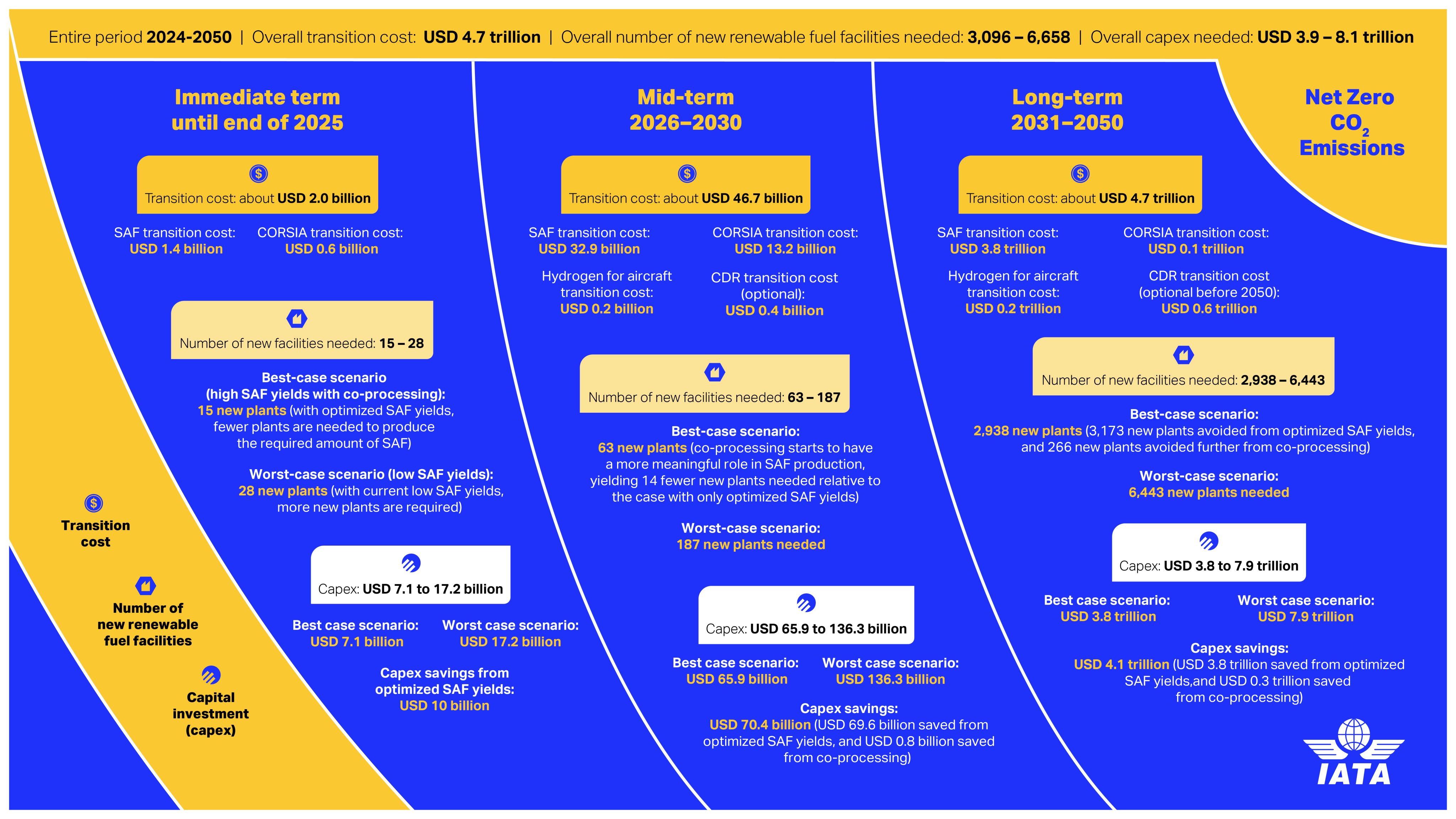
💸 That money will be required to upgrade our industry (e.g. to develop and purchase new aircraft, fuels and airport infrastructure) which will create lots of new aviation worker jobs, but the money will have to come from somewhere. The proposal here is one method for attempting to distribute this cost fairly onto those who benefit most from air travel, have the broadest shoulders, and the greatest capacity to pay.
👀 Watch this video explaining more!