
Aviation Industry Growth
Globally, the aviation industry is predicted to grow significantly in the coming decades.
Industry leaders claim there’s no need to limit flying to hit net zero, and say this growth will provide thousands more jobs in the sector. Whilst this may be true in the short-term, it will also mean we’re very likely to use up our carbon budget within the next decade.
This will mean that governments will then be forced to harshly regulate the industry in order to deliver legally-binding climate targets. This will, in turn, inevitably lead to massive and permanent job losses for aviation workers as our sector’s economic bubble bursts.
The proposed tech solutions to aviation decarbonisation are still decades away and have serious supply-side issues. Therefore, to stay within our carbon budget and safeguard lives and livelihoods, we need to talk seriously about demand management. This means conversations around policies such as controlling airport capacity and applying jet fuel tax, emissions pricing or frequent flyer levies need to be had within our sector.
Watch the video recording of our ‘Lunch & Learn’ detailing our group position on industry growth here:
Historic air traffic growth
Historically, global aircraft sales and air traffic have approximately doubled every 15 years.
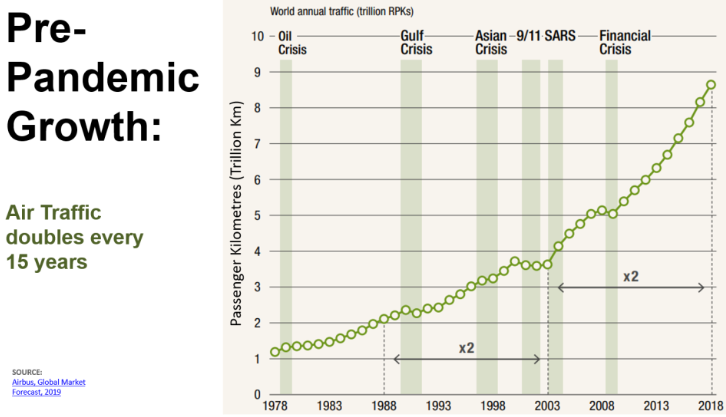
Despite all of our brilliant aircraft technology and airline operational efficiency improvements over the past 50 years, this massive air traffic growth has wiped out any emissions reductions, and we’ve actually seen a massive increase in emissions from global aviation:

Limits to ‘business-as-usual’ air traffic growth
The Intergovernmental Panel on Climate Change (IPCC), the International Energy Agency (IEA) and the UK Climate Change Committee (CCC), have all recommended policies which encourage behaviour change and limit air traffic growth in order to hit climate targets.
Despite this, the industry is ignoring this and is planning to more than double global air traffic by 2040. We think this is likely to fly us towards a major industry crash.
Many more factories, aircraft, airports and flights, means many more aviation jobs – right? In the very immediate short-term, i.e. the next few years – potentially, yes.
However, we have a big threat looming over us. We’re are on track to blow our global carbon budget for 1.5°C of global warming within the next 5-10 years:
In this now highly probable scenario, with the planet facing irreversible climate change, we run an increasing risk of runaway global warming, climate breakdown and ecological collapse. It’s highly likely that we’ll see increased heatwaves, crop failure, and water and food scarcity in many populated regions around the world. This could lead to drought, famine and mass migration. A prolonged global financial crisis will probably result. Read our detailed workshop analysis of these risks: here.
The risk to aviation, and its workers
With the carbon budget blown, it will become vital to rapidly reign in emissions. With fossil fuel subsidies removed, and their production ramping down rapidly, kerosene prices are likely to sky rocket. Alternative energy sources (such as biomass and renewable electricity) will also remain scarce in the face of increasing demand – forcing their prices up.
In this scenario, it’s very likely that governments will place enforced limits on flying and other high carbon or energy-intensive activities. This could lead to a “climate crash” within the aviation sector:
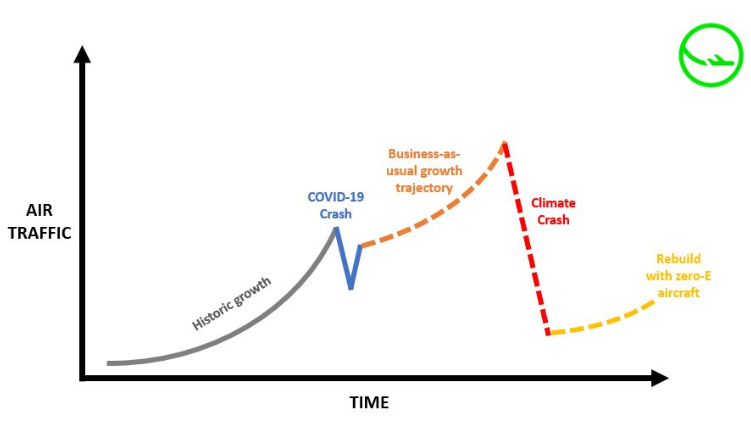
One of our expectations is that ‘business-as-usual aviation’ expansion today will lead to stranded assets for investors due to overcapacity of factories, airlines and airports for the number of flights that can realistically be taken using the existing fleet of aircraft.
A number of high-profile aviation business leaders have also come to this conclusion, including Sir Tim Clark, the CEO of Emirates Airlines who said that it is going to be “very difficult” for the industry to keep growing and meet the 2050 target. Marco Troncone, the CEO of Rome’s airports has also said that a “realistic pathway to cut aviation emissions is the best way the sector can prevent lawmakers from restricting flying on environmental grounds”. Continuing a business-as-usual approach would therefore be “very dangerous, in terms of negative restrictions and punitive policies” and that “Chances are high that in five years time, the level of attention [on polluting industries] will be higher than exists now. And at that time there will be zero tolerance”.
In this scenario, the aviation companies left overcapacity or stranded-assets will be forced to cut their costs in order to counter the loss of anticipated revenue. As happened during the Covid pandemic, we know that in this situation jobs will quickly be cut and workers will be the first to suffer.
An alternative narrative: “Towards a Safe Landing”
We can change the narrative by showing it’s in our self-interest as aviation workers to take rapid climate action and limit flying in the short-term for the best interests of our industry and our employment. This runs counter to the current dominant narrative that environmental action will be at the detriment to jobs.
We can present positive visions of the future for air travel that are filled with employment, even as we limit air traffic. We have a massive opportunity for jobs creation within the industry e.g. via technology development of ultra-efficient low-carbon aircraft, the transformation of airports, and a larger number of smaller, slower “zero emissions” aircraft.
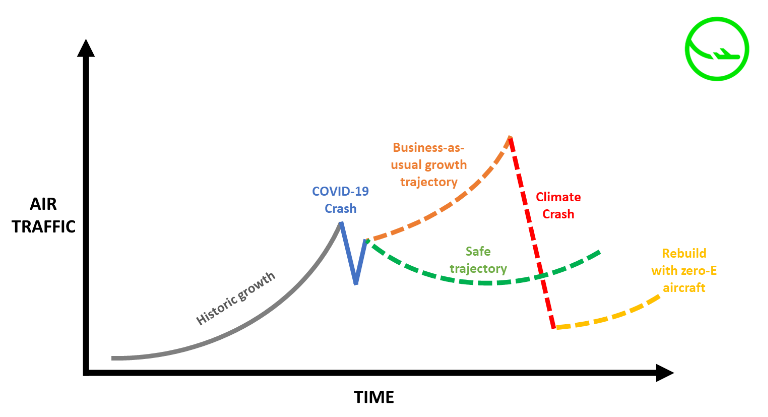
At Safe Landing we believe that flying less this decade will buy us time to transform aviation. It will help preserve the planet and tourist destinations for future generations, and will provide us with the best chance of being able to continue to fly into the future. Surely this is the safest trajectory for people, planet and workers?
Isn’t air traffic growth good for economic growth, jobs and workers?
Question:
Historically, there appears to be a trend where travel connectivity increases business and tourism for a regional – boosting it’s economy and providing employment for workers in the area. Will we not damage this, to the detriment of the economy, society and aviation workers if we attempt to limit air traffic?
Answer:
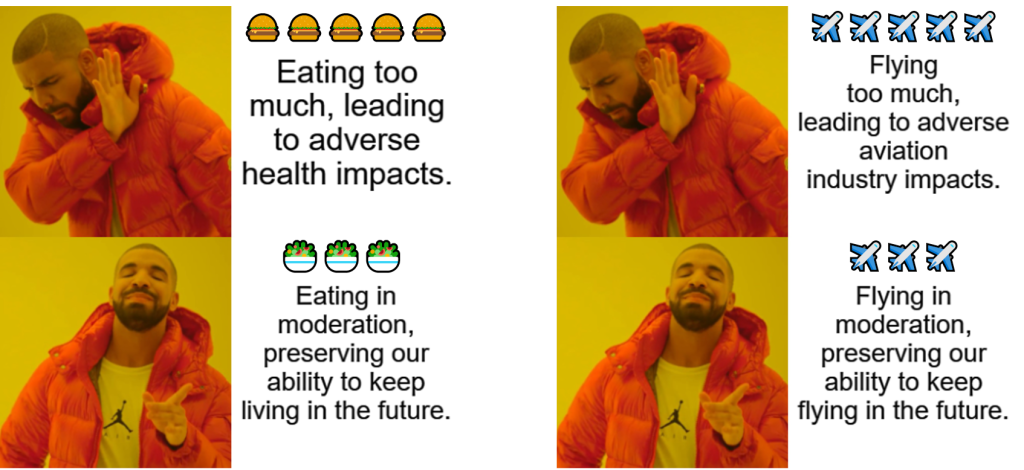
Think about flying like eating: we need to find moderation. Eating food allows us to stay healthy and gain nutrients, leading to positive impacts. However, eating too much will make us unhealthy and lead to negative impacts. If we consume too much food we may never recover our health. Similarly with flying: there are many positive social and economic impacts from global connectivity. However, by flying too much we may negatively and irreversibly destroy communities, nature, and our economies.
Is air traffic growth a matter of social justice?
Question:
If most air traffic growth is coming from the Global South, then how does restricting air traffic enable reduced inequality, and improve equity and fairness?
Answer:
At Safe Landing we understand that air travel is currently very inequitable, i.e., access to air travel is unfairly distributed around the world’s population.
We are often told that expanding global air traffic is therefore a matter of “social Justice” and spreading more air travel to countries who currently fly less.
However, while air travel can increase connectivity and provide economic benefits, we must also acknowledge that aviation emissions also provide massive climate risks which lead to ecological, social and economic risks.
Lower-income countries, which tend to be located in the ‘Global South’, and closer to the equator, face the greatest of these risks. Therefore, we think that air traffic growth can only be socially just in the context of reducing aviation emissions and impacts.
If air traffic grows in some countries, it will need to reduce in others in order to achieve this.
So if we are to enable ‘Global South’ countries to fly more, then this will necessitate a reduction in flying in the ‘Global North’. This is as per the International Transport Worker Federation (ITF)’s position (page 20):
“The aviation industry in the Global South must be given space to develop its aviation networks along sustainable lines to ensure the mobility benefits of aviation are more fairly shared among the global population.
Where there is a need to cap the growth of aviation (from 2019 levels) due to the slow pace of technological and structural change, it may be necessary to reallocate capacity to countries in the Global South.”
This is why we engage with airport planning consultations/inquiries in e.g. Europe, the UK and US to advise against airport expansion. This is because the number of flights per person in these countries are far higher than the global average:
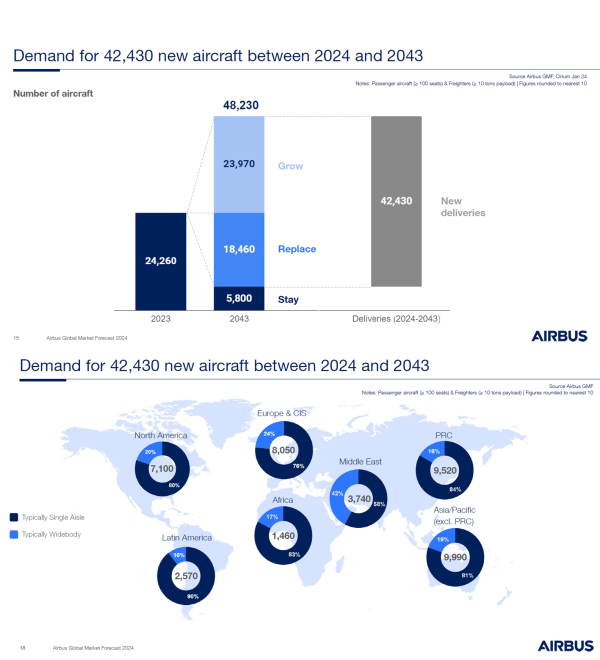
Yet despite this, much of the current projected air traffic growth over the next 15-20 years is planned to take place in North America and Europe:
Is all air traffic growth the same?
No, when we talk about need to limit the growth of air travel, we are referring to conventional air traffic involving conventional fossil fuel-powered aircraft: Airbus A320s, A350s, A330s and Boeing 737s, 777s, 787s etc. if we implement the necessary policies (carbon budgets and carbon pricing) etc. then we expect to see demand for these aircraft and flights curtailed.
There are new forms of aircraft such as zero-carbon (electric or hydrogen) and hybrid-powered aircraft being developed that can significantly or completely eliminate the use of fossil fuels. These aircraft can be a genuinely clean growth area for aviation.
However, it is important to note that zero-carbon and hybrid-powered aircraft will initially be far smaller (10-30 passengers vs. 100-400 passengers of conventional aircraft) and fly shorter ranges, so we need a new air transport system: including new airport designs and air traffic network designs to accommodate these aircraft. But as the aircraft will be smaller, slower and shorter range, there is no reason why there can’t be more pilot, cabin crew, airline and airport worker jobs created to cater to this market – even as conventional aviation growth is curtailed.