

Article written by Finlay Asher, aerospace engineer, and member of Safe Landing.
Safe Landing attended Aircraft Leasing Ireland (ALI)’s “Global Aviation Sustainability Day” conference in Dublin on 12th November 2024.
I travelled from Scotland to Dublin via train and ferry, using the UK-Ireland ‘Sail & Rail‘ scheme which pairs train and ferry tickets in a relatively cheap combination. As this trip took place at the same time as COP29 in Azerbaijan, where most attendees were flying in to attend the talks, it was nice to model sustainable, grounded travel while attending this conference:
The views from the ferry deck were also brilliant during sunset across the Irish Channel:

The aircraft leasing industry
Ireland is a leading centre for aircraft leasing globally. This is due to it’s it’s low tax regime, it’s long history in the business, and it’s geographic position between North America and Mainland Europe which have historically been the key aviation regions.
Aircraft leasing companies, known as lessors, own over half of the world’s aircraft fleet used by airlines. Some of the biggest lessor companies, such as AERCAP, are based in Ireland. AERCAP alone owns a fleet of over 1700 aircraft. Compare this to the 600 aircraft owned by Ryanair, who are Europe’s largest airline, and you begin to see the size and influence of these companies.
The “Global Aviation Sustainability Day” conference
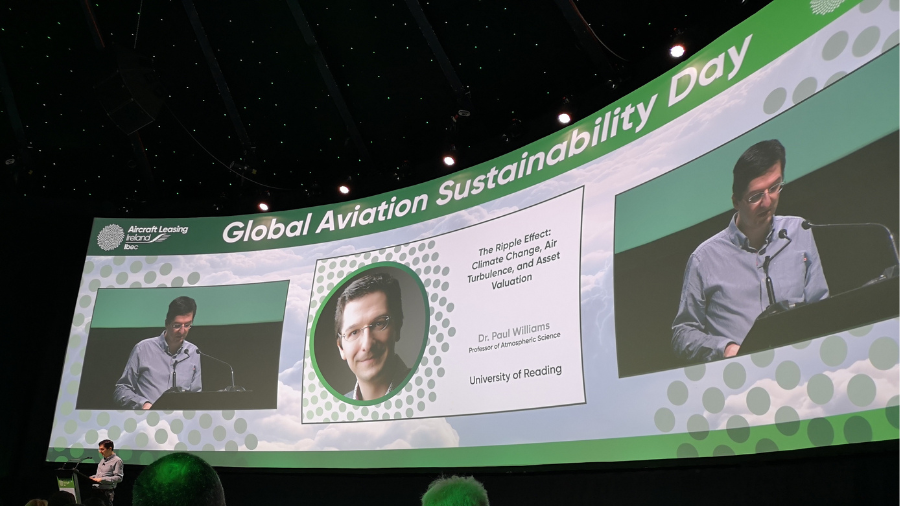
The conference kicked off with a presentation setting the scene from Paul Williams, Professor of Atmospheric Science at the University of Reading. Paul highlighted his work on increased air turbulence due to global atmospheric warming, causing safety issues for passengers, flight crew, and the airframe structure itself. He stressed the point that increasing climate impacts are already locked-in due to the lag between man-made CO2 accumulating in the atmosphere and impact occurring later. We already need to prepare to adapt for these impacts on aviation which include sea level rise and flooding of many airports, wildfires at destinations and heat waves preventing aircraft from taking-off at full capacity or at all. We have previously talked about these issues alongside Paul Williams on the BBC.
Novel Aircraft
A few presentation slots were given to start-ups building disruptive, alternative aircraft. These included Heart Aerospace (hybrid-electric), Wright Electric , (battery-electric) and Jet Zero (Blended-Wing Body aircraft):
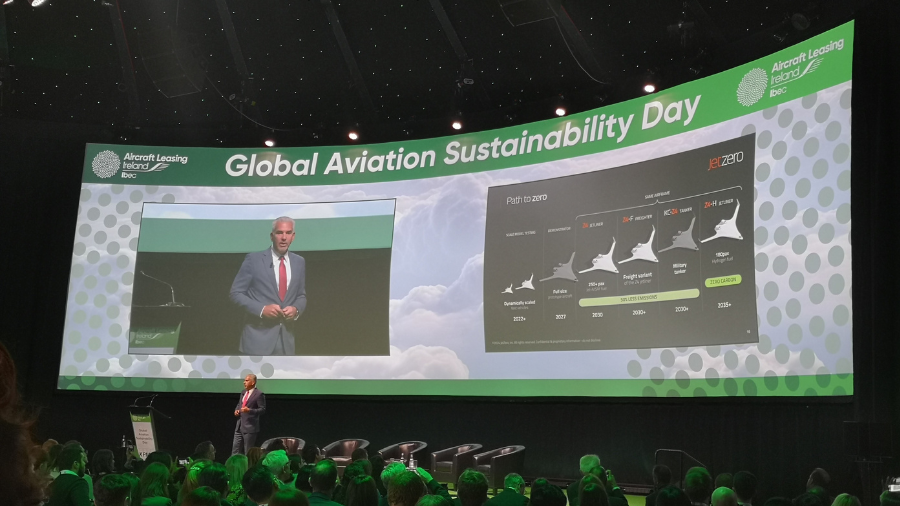
Some of these companies are doing genuinely innovative things: we are particular fans of the simplicity and practicality of Heart Aerospace’s hybrid-electric design (a reminder to attend our next expert talk on this topic) and of Jet Zero’s attempt to make Blended-Wing Bodies (BWBs), the holy grail of aerodynamically efficient and low-noise aircraft designs, a reality.
The disruptive companies all highlighted the issue of the aerospace manufacturing duopoly (Airbus & Boeing) that has had a dampening effect on innovation. This is because neither incumbent airframe manufacturer is incentivised to take the risk with developing an unconventional aircraft design if their competitor does not. Yet, these are probably the only companies that could ever stomach the multiple tens of billions of dollars required to design, develop, certify and productionise a large aircraft.
When leaders from the lessor industry were questioned about placing orders for novel aircraft, they pointed to the fact that they haven’t yet been commercialised so cannot be purchased, rather than feeling any responsibility to help develop them or indeed any existential threat if those developments fail to deliver.
Renewing the aircraft fleet
The rest of the conference focused very much on ‘business as usual’ fleet growth, buying the newest aircraft, and the usual industry talking points of “Sustainable Aviation Fuel” or “SAF”.
In absence of new alternative aircraft, fleet renewal: simply buying the most fuel-efficient conventional aircraft available today, was seen as a priority. Most of the industry’s focus was on the long backlog created by supply chain issues including Covid-19; Boeing delays, safety concerns and internal worker strikes; and unexpected maintenance issues faced with several of the latest jet engines.
However, we’ve spent the last 50 years simply making conventional aircraft more efficient and know that this has resulted in overall aviation emissions increasing, not reducing. We also know that we’re into marginal gains with efficiency improvements of conventional tube-and-wing aircraft:

A recent report from the International Council on Clean Transportation (ICCT) said that around 50% of the aviation’s remaining carbon budget will be consumed by aircraft already in service, and the remaining 50% will be consumed by lifetime emissions from new aircraft deliveries by about 2035. The ICCT conclude that all new aircraft delivered by the mid-2030s will need to emit net zero emissions throughout their operational lifetimes.
We can’t just rely on slightly more efficient aircraft and engines: the leasing industry, and the aviation industry more generally, must be prepared to try something else.
Scaling “Sustainable Aviation Fuel”
The term “Sustainable Aviation Fuel” or “SAF” was repeated more than anything else throughout the conference. It was the phrase on everybody’s lips, yet there was little nuance about whether some fuels are more sustainable than others, and whether some of the fuels proposed are even sustainable at all. Safe Landing have our own detailed position on so-called “SAF”, or alternative jet fuels which can be read here.
It was notable that Gevo, an American biofuels company, were present on one panel to extol the virtues of their corn crop-based aviation biofuels – a product that is banned in the EU, and by extension in Ireland, due to concerns with land-use change.
When it comes to energy-intensive ‘green hydrogen’ or electro-fuels’ the large amount of renewable energy required and competition over scarce resources with other sectors was rightfully highlighted. E.g. Andy Cronin, CEO of Avolon pointed out: “What’s at stake is the competition for clean energy. An important policy decision is who is prioritised for that. One Artificial Intelligence (AI) search uses 10x the energy of a Google search and this will put real pressure on availability of renewable energy over the next 5 years”.
One fundamental principle of economics is that high demand vs. low supply leads to inflated commodity prices, and the cost of energy could be set to soar due to not only the rise of AI, but also the electrification of other sectors of the economy such as buildings and ground transport.
Crucially, there was also no clear agreement on who should pay for the astronomical prices for these fuels.
Financing the Transition
Some have noticed that lessors appear to be a profitable segment of the aviation sector which have so far remained off-the-hook for financing the transition to zero carbon flight. During the conference, banks, airlines and aerospace manufacturers all called on lessors to use their capital in support of climate action – be that alternative aircraft or alternative fuels.
Throughout the conference IATA’s calculation that decarbonising aviation is going to cost around $4.7trn between now and 2050, a massive $175bn/year, was repeatedly referenced.
As Michael Halaby of MUFG said during one of the panels: “We need to be very careful when talking about people’s taxes being used to subsidise other people’s travel or flights. Even populists governments would want to avoid increasing income tax on the general public at large in order to subsidise sustainable aviation”.
So where is that money going to come from if not from the aviation industry itself, those who profit from it, and those that use aviation the most?
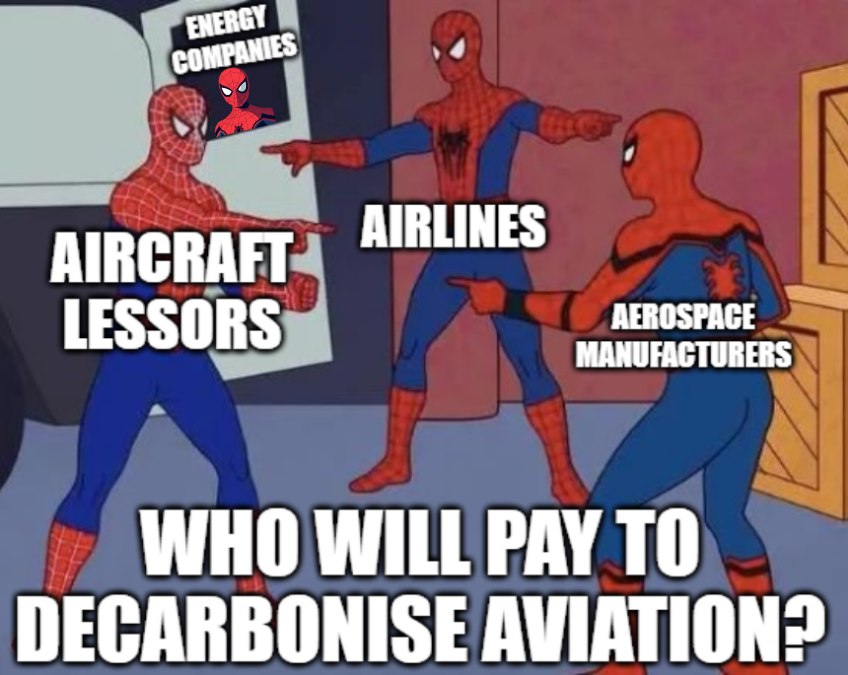
Each section of our industry is playing a game of ‘hot potato’ and deflecting from the topic, by pointing their fingers at the other sections. Meanwhile, energy companies who are currently making massive profits from the sale of fossil fuels, and who should really be on the hook for developing alternative low-carbon aviation fuels, were visibly absent from the conference:
Ultimately, we need to escape the delusion of low-cost flights remaining a thing, particularly for frequent long-haul air travellers. Airline industry net profits are expected to reach $25.7 billion in 2024. So we cannot finance the $175bn/year required to transition unless air passenger costs increase. This will likely have to be raised by applying higher aviation fuel/emissions pricing which will be passed on to passengers by airlines. Although we arguably could, and should, ensure such pricing is socially distributed via policies such as frequent flyer levies, and minimised through taxation of energy company profits.
Paying for our Pollution
It’s not just our own transition that aviation needs to consider stumping-up the cash for, it’s also the notion of the “polluter pays principle”. This is the idea that polluting industries such as aviation, and wealthy, polluting individuals such as frequent flyers should pay compensation for their climate impact.
Loss & Damage finance was the main topic at COP29 in Azerbaijan that week, and the negotiations ended with fury from low-emitting, climate-vulnerable, ‘developing’ nations at the paltry sums of finance being offered by high-emitting, wealthier ‘developed’ nations. One way of boosting this finance, proposed by both climate-vulnerable countries and by the IMF, is a higher tax on international aviation and shipping. Haldane Dodd, Executive Director or the Air Transport Action Group (ATAG), mentioned at the conference that such proposals have been “put on the table numerous times at previous COPs” and he viewed them as low risk.
Rather than a risk, we see these as more of a moral and scientific obligation, and as an inevitability. This is something we need to prepare for, rather than simply focusing our efforts on lobbying and delay.
Kata Cserep, Global Aviation Lead at PA Consulting, flashed up a chart during one of the most incisive presentations of the day, showing the frankly insanely-low forecasted price for international aviation emissions under the CORSIA scheme, versus the forecasted EU Emissions Trading Scheme (ETS) pricing:
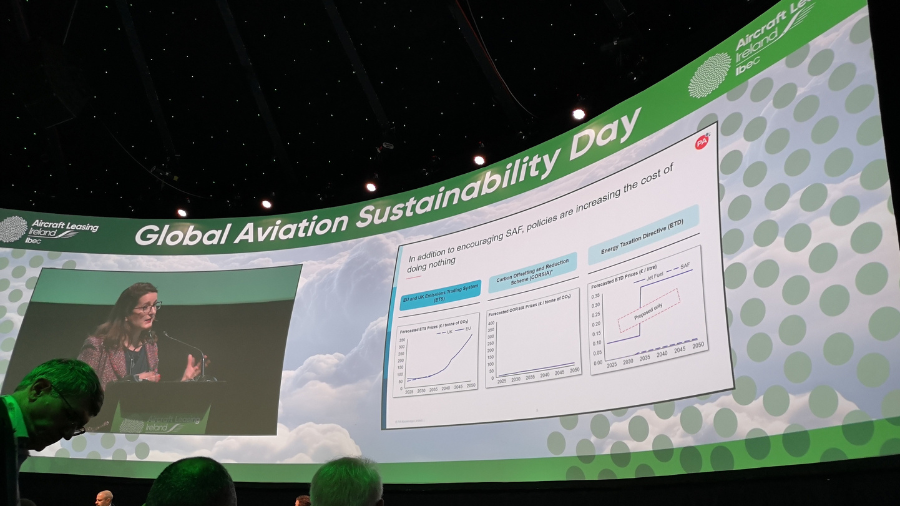
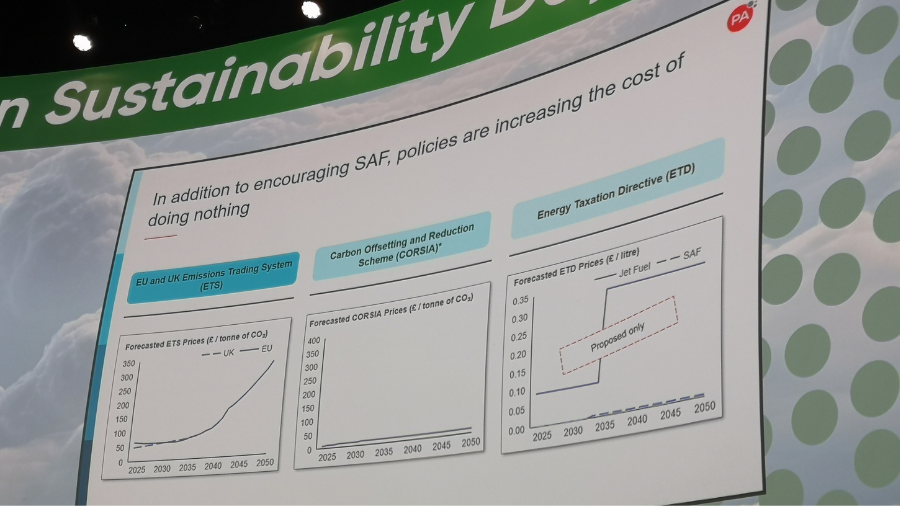
It’s abundantly clear to us that the low emissions prices of CORSIA are unrealistic, unsustainable and we’ll soon be faced with a cliff-edge of far higher pricing across all aviation. Lessors should take note, as this will drastically impact the demand for their airline customers’ flights, and may well mean that some airlines struggle to fulfil their leasing contracts.
Interview with Boeing
On the side-lines of the conference, we managed to secure a Safe Landing interview with Brian Moran, Chief Sustainability Officer (CSO) of Boeing. Boeing are clearly one of the largest aviation companies in the world, so it was exciting to interview somebody in such a senior sustainability position about their vision for the future of air travel. Video interview coming soon!:
