
The 2024 United Nations (UN) Climate Change Conference: the ‘Conference of Parties’ (COP), or COP29, is taking place in Baku, Azerbaijan, from 11-22 November 2024.
COP29 comes at a pivotal moment, as countries are due to submit new national climate plans – Nationally Determined Contributions (NDCs) – over the next year. The ambition of these plans will be crucial in driving the pace of climate action throughout the next five years. It will likely become impossible to prevent global heating exceeding 1.5°C without huge transformative leaps forward every year until 2030.
It’s very difficult to enter Azerbaijan via their land or sea borders, so the majority of participants and attendees will likely travel there by air on international flights.
Aviation emissions within the COP process
Ironically, it’s very unlikely that any progress will be made at the conference on policies designed to reduce the climate impact of aviation. This follows a historic tendency to relegate international aviation emissions to the responsibility of the International Civil Aviation Authority (ICAO) rather than the UN process. As such, these emissions are not usually included within state ‘Nationally Determined Contribution’ (NDC) submissions.
However, a legal analysis for Transport & Environment in 2021 confirmed that international aviation emissions should be included in the NDCs as these submissions must include “economy-wide emissions”.
Furthermore, the only significant policy measure implemented by ICAO has been the Carbon Offsetting and Reduction Scheme for International Aviation (CORSIA). This scheme has been evaluated as “too broken to fix”, enables CO2 pollution to increase, doesn’t even cover most emissions, and relies on flawed carbon offsets.
We believe this is a situation that needs to urgently change.
Our proposals
Safe Landing advocates for all countries to:
1️⃣ Include international aviation emissions in NDCs submitted in 2025.
2️⃣ Include total climate impact of aviation (e.g. contrails) in the NDCs.
3️⃣ Establish an “Aviation Ambition Coalition” to lead on aviation climate action.
4️⃣ Introduce an international air passenger levy.
More detail for each of these proposals can be read below.
1. Accounting for international aviation emissions
We want to protect our sector and ensure that we’ve future-proofed air travel. An obvious and vital first step is accounting for international aviation emissions in national climate plans. There is no escaping it: these emissions exist. We must account for and mitigate them. Lack of accounting leads to lack of mitigation strategies and policies being developed. As aviation workers, we’re worried that if we don’t implement these policies soon through early design, we’ll end up having to impose them through late disaster instead.
2. Including total climate impact
The total climate impact of aviation includes contrail formation as well as other non-CO2 emissions such as nitrogen oxides (NOx), water vapour, soot and sulphate aerosols.
Despite uncertainties, there is scientific consensus that non-CO2 emissions currently account for a majority of aviation’s climate impact. Avoiding the formation of warming contrails in particular is likely to be the fastest way to reduce aviation’s climate impact.
As with CO2, we’re confident that non-CO2 emissions also exist and contribute to global heating. As such, we must also account for them and develop mitigation plans.
3. Establishing an “Aviation Ambition Coalition”
As with global climate policies in general, we need certain countries to lead the way on climate action within aviation. Just four jurisdictions are responsible for a quarter of international aviation CO2 emissions. In 2019 these were the EU27 (10.4%), the United States (7.9%), China (4.4%) and the United Kingdom (3.9%). Japan, the United Arab Emirates, and India are also significant: each was responsible for 2–3% of CO2 emissions from international aviation in 2019. Within the European Union: Germany, France, and Spain have the highest emissions.
We advocate for countries such as these to form an “Aviation Ambition Coalition” which leads on progressive aviation policies and mitigation strategies, rather than wait for multilateral agreement from all 198 member states taking part in the COP process.
Furthermore, we advocate for a transatlantic partnership (North American and European countries) to commit to COntrail MITigation (COMIT).
This is for the following reasons:
- North America and Europe have a strong pedigree in aviation. They have a history of leading the cutting-edge in aviation research and are home to the majority of the world’s leading aerospace companies.
- Their populations fly more than any other continent, they’re also relatively wealthy and can easily afford any (relatively low) costs of additional measures.
- Coincidentally, most warming contrails occur in the Northern Hemisphere, across North America, Europe, and the North Atlantic:
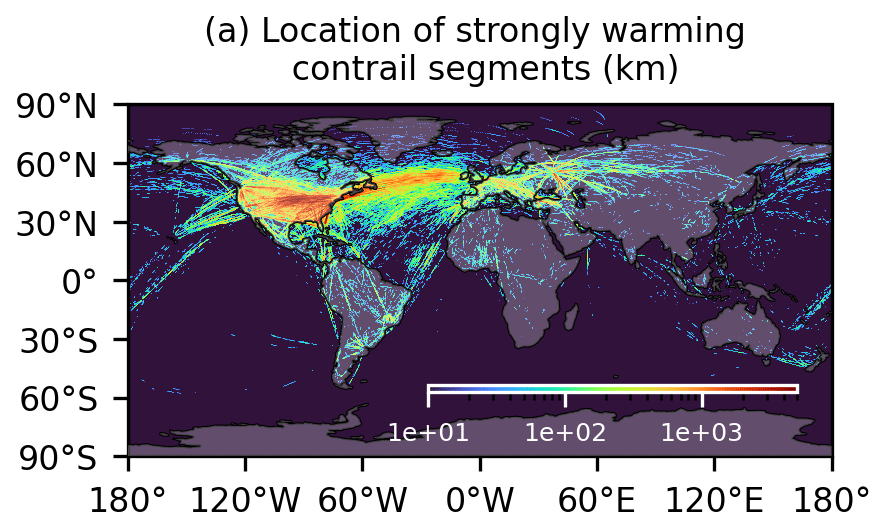
Modelling from Roger Teoh et al., Figure 9(a): showing global concentration of strongly warming contrails
These areas are therefore also best placed to rapidly mitigate the non-CO2 impact of aviation.
4. Introducing an international air passenger levy
We advocate for replacing the ineffective CORSIA scheme with a more effective international aviation emissions levy which covers all emissions and prices them more progressively, ideally like a frequent flying levy. In absence of this, we advocate for an ‘ambition coalition’ to agree bi-lateral agreements to price emissions higher between those countries.
Such a levy could raise important finance for decarbonisation, and a significant portion of the money raised could be used for ‘loss & damage’ funding which will be a key topic at COP29.
The loss and damage in developing countries is already estimated by some studies to be greater than $400bn annually – and expected to rise – so time is of the essence.
In 2009, wealthy nations pledged to “mobilise” $100bn in “climate finance” annually by 2020 to help vulnerable nations deal with climate change. However, this has yet to be delivered, and the latest announcements go nowhere near the levels of finance needing to be delivered to support developing countries. The $700m pledged to loss and damage fund at last year’s COP28 covers less than 0.2% of the estimated losses developing countries face each year.
A global aviation tax to pay for climate finance for the most impacted countries has been proposed at previous COPs, e.g. by the Maldives in 2008 to fund climate adaptation, and was proposed again by the ‘Least Developed Countries’ (LDC) group in the run-up to COP27 in 2022. These are the lowest-income countries and are the most vulnerable to immediate climate impacts. We should feel a moral responsibility to listen to, platform and amplify their demands.
What can you do about it?
Let’s push collectively for aviation emissions and their mitigation policies to be included within national climate plans.
If you’re an aviation worker, concerned about the climate, and the future of our industry – sign-up to Safe Landing to discuss how to do this most effectively!