

The UK has just finished its “party conference season”, with all the main political parties holding their conferences in the last month. Safe Landing members attended the Liberal Democrat, Green and Labour Party conferences to have discussions, make connections and learn while trying to influence policies. (We also attended TUC Congress, the national conference of almost all UK trade unions, earlier in September.)
Safe Landing is not party political, but our work is political in a broader sense; we are waging a struggle rooted in the workplace but with much wider connections and implications, and our demands include ones that necessarily require government-level action. All three of the political party conferences we attended were instructive and useful in different ways.
Labour conference
In some ways the Labour Party conference (8-11th October, Liverpool) was difficult territory. This year, as we reported in advance, it was flooded with representatives of big corporations jockeying for position in expectation of a Labour government, including greenwashing energy, hydrogen, carbon capture, and aviation companies, and the Labour leadership shows worrying tendencies of sympathy towards them.
But at the same time, the event was also important “from the other side”: despite all this, Labour still maintains organisational and broader links with trade unions, which have large numbers of delegates to the conference; large numbers of trade unionists and other activists sympathetic to climate and workers’ struggles remain in the party and attend the conference and events alongside it; and the bulk of MPs supportive of these causes are Labour MPs.
Meetings at the conference
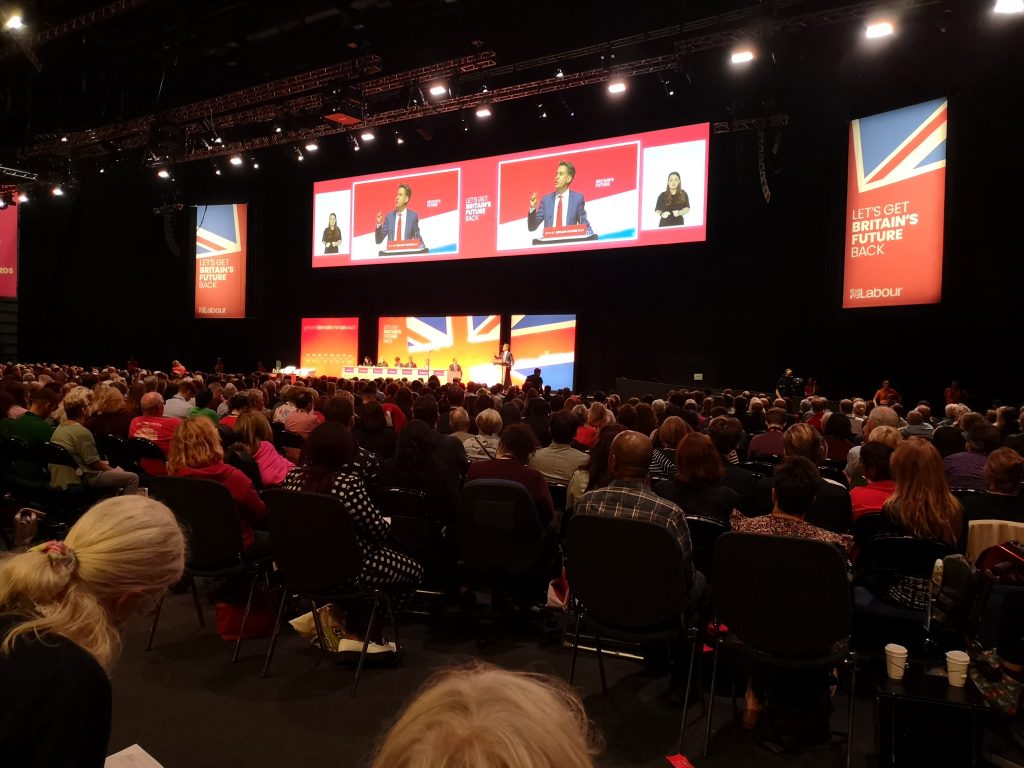
Ed Miliband MP, Labour’s Shadow Secretary of State for Energy Security and Net Zero, speaks to the conference
Unfortunately, no motions on climate made it to the final agenda the conference itself debated and voted on. This obviously reflects a problem, one that is probably multifaceted (including different kinds of small-c conservatism from the party leadership and trade unions).
During our several days in Liverpool we attended multiple conference fringe events, including a number taking place as part of The World Transformed (TWT) political festival that runs alongside the Labour conference, and grabbing many opportunities for informal discussions too. Finlay had an official pass to go into the ACC venue where the main conference was taking place as a visitor. Throughout we distributed our leaflet introducing Safe Landing and our work.
At the Labour conference itself, fringe events we attended included one on decarbonising the grid organised by the Green Alliance and the New Statesman; a “Great British Nuclear” event where the nuclear lobby was pushing hard for a future Labour government to greenlight and speed up nuclear reactor builds; and, more at the worker-climate end of the spectrum, a discussion on just transition in the energy sector organised by official Labour environment group SERA, where we met and had a useful discussion with Sue Ferns, the deputy general secretary of technical union Prospect.
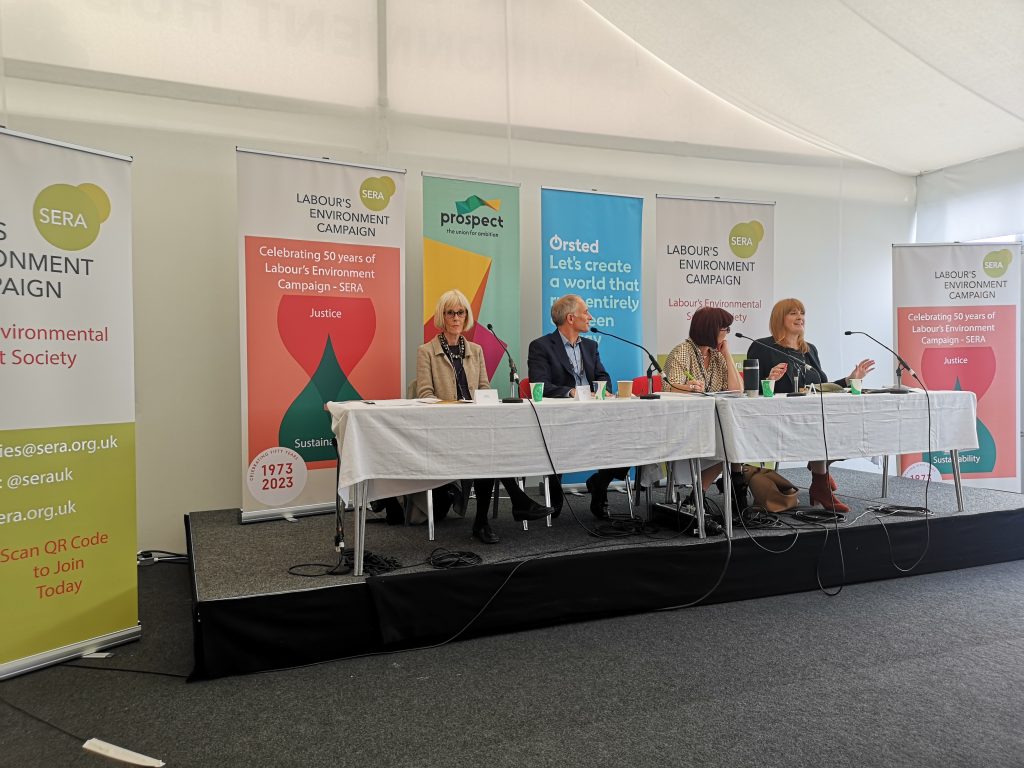
Sue Ferns of Prospect union speaks at fringe event organised by SERA on Just Transition in the Energy sector
A theme at many of these events was a criticism from Labour MPs, companies, and NGO speakers of the current government’s lack of clear industrial strategy in many sectors: be that energy, transport, manufacturing, agriculture or buildings. We clearly agree with this analysis when it comes to our own aviation sector, and the UK Governments deeply problematic “Jet Zero Strategy” which amounts to a wish-list of fanciful scenarios, rather than delivering the necessary policies that can drive the rapid technological development, behaviour change, and radical re-configuration of the air transport network which we believe is required.
However: Sarah Jones, Labour MP and Shadow Minister for Industry and Decarbonisation, stated at one event we attended that, when it came to Labour producing their alternative industrial strategies, they “would listen to industry, who will tell us clearly what to do”. So, the question remains: when it comes to “listening to industry”, will Labour listen to the voice of short-termist business leaders? Or, will they also consult and listen to trade unions and workers at the grassroots level, who have most skin in the game, the greatest subject-matter expertise in their workplace – and generally the longer-term view of a desire to stay in a stable and secure career over many decades, rather than the shorter shelf life of the average chief executive?
The World Transformed – fringe conference
The sessions we attended at The World Transformed included one on “How can the climate movement be in solidarity with workers?”, organised by social justice NGO NEON and the TUC. Discussions during and afterwards allowed us to follow-up some existing connections, for instance with the TUC’s Just Transition team and in Unite the Union. We were pleased to meet John Cooper, Unite convener from the local Stellantis factory, which has transitioned to electric van manufacturing – who is also the chair of Unite’s Automotive national industrial sector committee (NISC). We hope to present our concept of Workers’ Assemblies to the Unite Automotive NISC at a future date, and John sounded receptive to this idea!
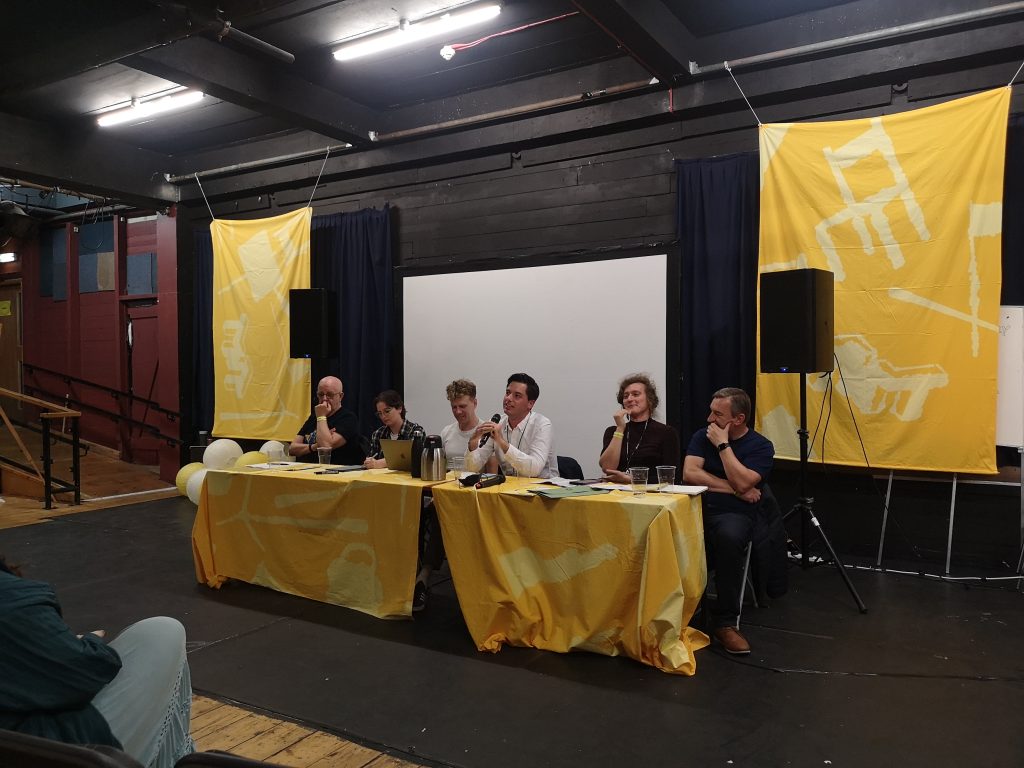
Speakers at ‘The World Transformed’ Conference, including from Unite the Union (automotive, steelmaking), the TUC, Yorkshire Trades Council and NEON
We attended a range of other TWT sessions, including ones on “eco-socialism” and local community organising (including through Citizens’ Assemblies), and on struggles to defend and reinstate trade union rights as they come ever sharper attack from the government.
We also made some international contacts, including a US speaker in the eco-socialist session who said she’d put us in touch with aviation workers she knows there, and a member of the India Labour Solidarity campaign (whose social we attended) with aviation worker contacts in India. We’d like to discuss further with that campaign around the issue of biofuels production in India too.
The corporate side
We used our conference visitor pass to visit many of the stalls run by greenwashing corporations and engage in discussion with their representatives!
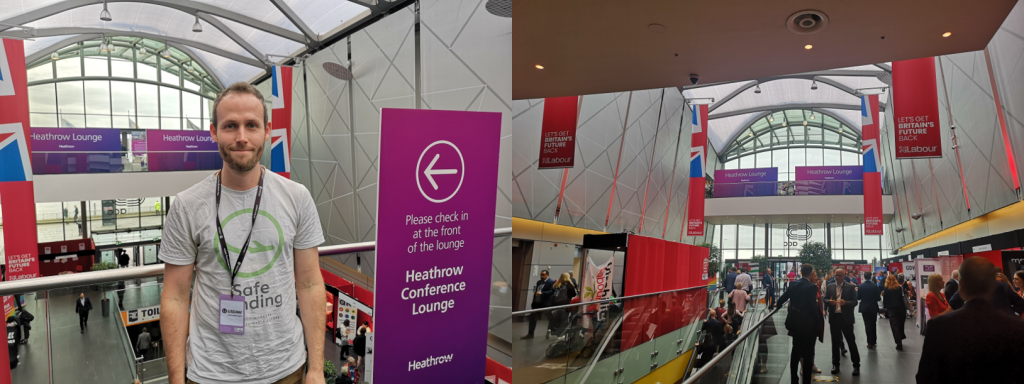
Labour Party Conference? Or a Heathrow Airport terminal?
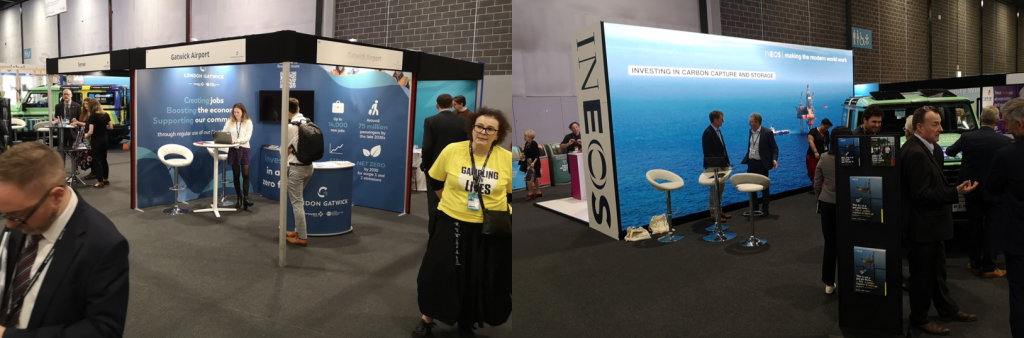
The main conference venue was filled with stalls from many companies, including airports like Gatwick, and major polluters like Ineos flogging hydrogen vehicles and ‘carbon capture’
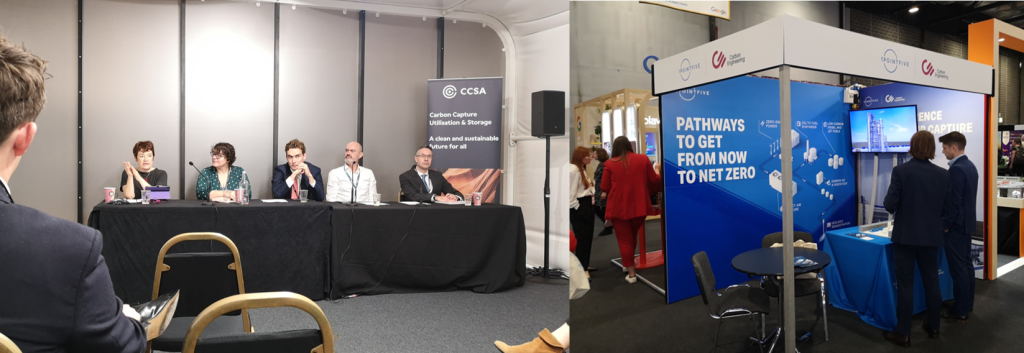
Carbon Capture? Or corporate capture of politicians?
At the CCSA (Carbon Capture & Storage Association) event, we asked the Labour politician on the panel why, in a cost-of-living crisis, the taxpayer should be subsidising/financing polluting companies (such as Shell and Ineos, who are massively wealthy and have profited off the recent elevated cost of energy) to develop carbon capture facilities, rather than making polluters pay for the technology themselves. This point was actually agreed to by the politican, but caused some looks of consternation amongst the rest of the panel.
We also spoke to some “energy-from-waste” specialists who were highly sceptical about the efficacy of certain “Sustainable Aviation Fuel” (SAF) refineries announced around the UK, which was interesting.
There were also some trade groups who were well worth talking to, including “RenewablesUK” (we spoke to Abi Beck and Ajai Ahluwalia) who are advocating for faster renewables build across the UK, and were interested in our proposals for a ramp-up in aviation fuel tax to help fund this.
An ally on Heathrow
We had meetings with two Labour MPs with strong records of support for both climate-related and workers’ issues and struggles: Nadia Whittome from Nottingham East and John McDonnell from Hayes and Harlington (West London).
Our meeting with Nadia was useful but very brief (as you can imagine MPs spend the conference rushing from one meeting to another), and we agreed to follow up for further discussion. We got more time with John McDonnell, which was extremely valuable.
John was shadow chancellor when Jeremy Corbyn was Labour leader. He is MP for the area that includes Heathrow Airport and has extensive links with workers and their unions there (as well as more widely). However he has also helped lead campaigns against the expansion of Heathrow, on grounds of disruption to the local community and also climate change. When he was in the leadership of the Labour Party, the party opposed Heathrow expansion; with growing corporate influence under the new leadership, the party has gone silent and this stance could be under threat. With Heathrow Airport branding plastered above the main conference building, and an exclusive “Heathrow Lounge” for Labour MPs to book meetings – essentially a space decorated heavily with posters marketing the benefits of “Sustainable Aviation Fuel” (SAF) subsidies/investment in the UK – it certainly appears that the corporate marketing teams currently have the upper hand currently!
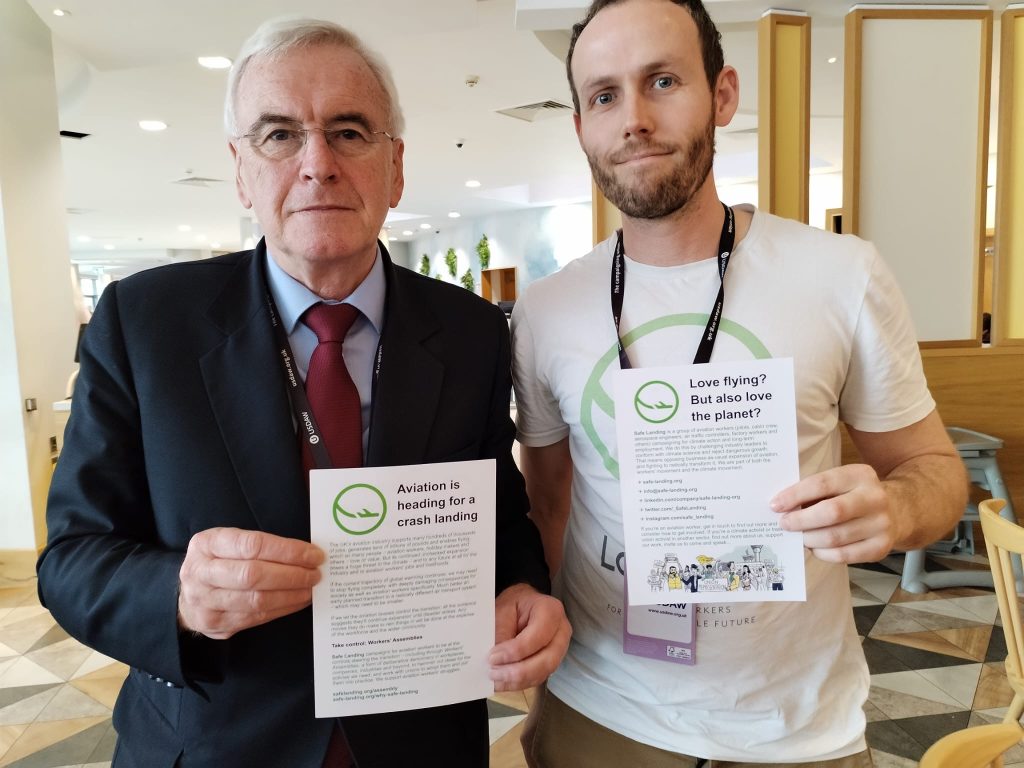
Labour MP John McDonnell meeting Finlay Asher from Safe Landing
John has a clear understanding of how climate and workers’ issues intersect in the expansion of aviation, including the crucial point that despite the rhetoric, expansion is not creating more jobs. It was a very fruitful discussion and we’re looking forward to following up to make plans on how we can work together. In particular, we’re planning a parliament campaign day in Westminster in early 2023 with the climate-action group, Possible, and are also looking to advance our campaigns on the non-CO2 emissions from aviation, including contrail avoidance and air pollution affecting airport workers and nearby communities.
We also met a lot of grassroots Labour activists and CLP (local constituency party) officers, and have already had one invitation to speak at a CLP.
Campaigning
In a way everything we did in Liverpool was campaigning. While there, we also found time to help with some other specific climate campaigning, including by helping Unite Grassroots Climate Justice Caucus members and others demonstrating/petitioning for a commitment from Labour to cancel Rosebank alongside other new fossil fuel projects; and meeting and demonstrating with Green New Deal Rising (see cover image at top). We also took the new pamphlets civil service union PCS has produced for its National Climate Service initiative and distributed them at The World Transformed (arguably PCS missed an opportunity by not doing more on this at the conference).
A lot to follow up on generally!