
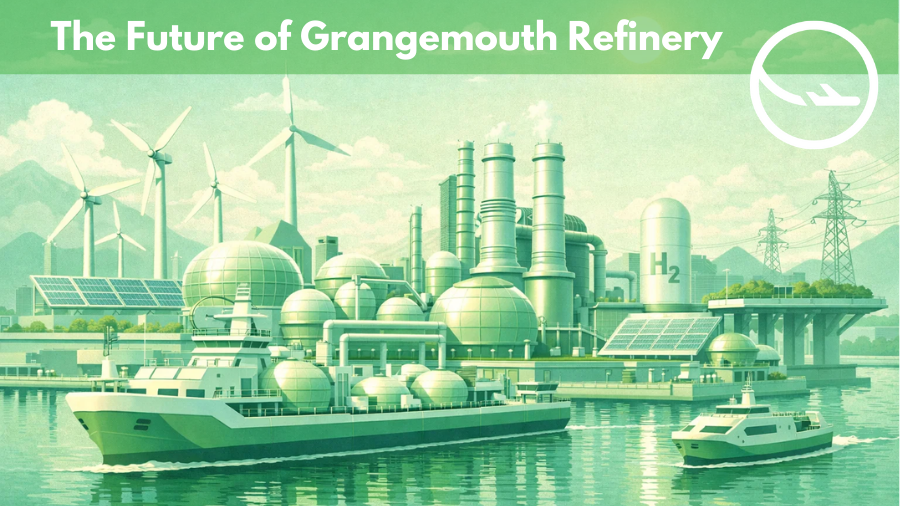
In April 2025 Grangemouth refinery stopped processing crude oil after a century of operations in Scotland, with over 400 jobs being lost.
In Dec 2025, £120 million of government support was announced to keep the plastic production at Grangemouth going.
Finlay Asher, aerospace engineer and member of Safe Landing, spoke to LBC News about this announcement, what it means for workers and what more we’d like to see happen around the future of this site, which could make use of the existing refinery infrastructure, now closed, to produce the alternative jet fuels of the future:
Watch our interview on ITV earlier in 2025 about the closure of the refinery here:
Read our blog post from April 2024 about a low-carbon transition plan for Grangemouth: https://safe-landing.org/grangemouth-refinery
We have also contributed to a briefing paper produced by Green Alliance in Nov 2025: “Prospects for Grangemouth: risks, opportunities and policy options” which proposing securing investment in scalable no regrets projects that can be rapidly implemented. These include:
- Anaerobic digestion using local biomass – this recycles the nutrients from food/farm/forestry waste into organic fertiliser and creates biogas and carbon as a by-product which could be used as an input to alternative fuel production.
- Green hydrogen production from renewable energy – initially displace ‘grey’ hydrogen (produced using fossil fuels) at Grangemouth, then later produce green fertiliser/ammonia to displace fossil-based fertiliser and use as an input to alternative fuel production.
- Carbon capture demonstration projects – technologies that remove carbon from the air and from industrial processes could be trialled using aviation tax revenue. The captured carbon could be used to for producing alternative fuels or chemicals.
- Local renewable power – Grangemouth is located in the North East of Scotland where there is abundant wind energy. Opportunities for local wind energy projects and other renewables with private wire connections should be explored to provide power to the site as a whole and support green hydrogen, carbon capture trials and alternative fuel production.
In the longer-term, Grangemouth is perfectly placed due to it’s geographic location, existing skills base, port infrastructure, proximity to renewable energy sources and existing fuel supply chains to airports in Aberdeen, Edinburgh, Glasgow and Newcastle to produce and supply low-carbon alternative aviation fuels. Innovative policy that can be put in place to harness aviation tax revenue to first scale the building blocks required – renewable energy, biomass collection, carbon capture and green hydrogen/chemical production – at and nearby Grangemouth could accelerate this transition, generate clean economic growth, utilise the existing workforce and create new highly-skilled jobs in the area.