

Background
Contrails, short for condensation trails, are clouds created by aircraft flying through cold and humid areas of the atmosphere. These reflect sunlight and have a low cooling effect during the day, whilst persistent night time contrails trap heat like a blanket and warm our planet’s atmosphere, contributing to global heating:
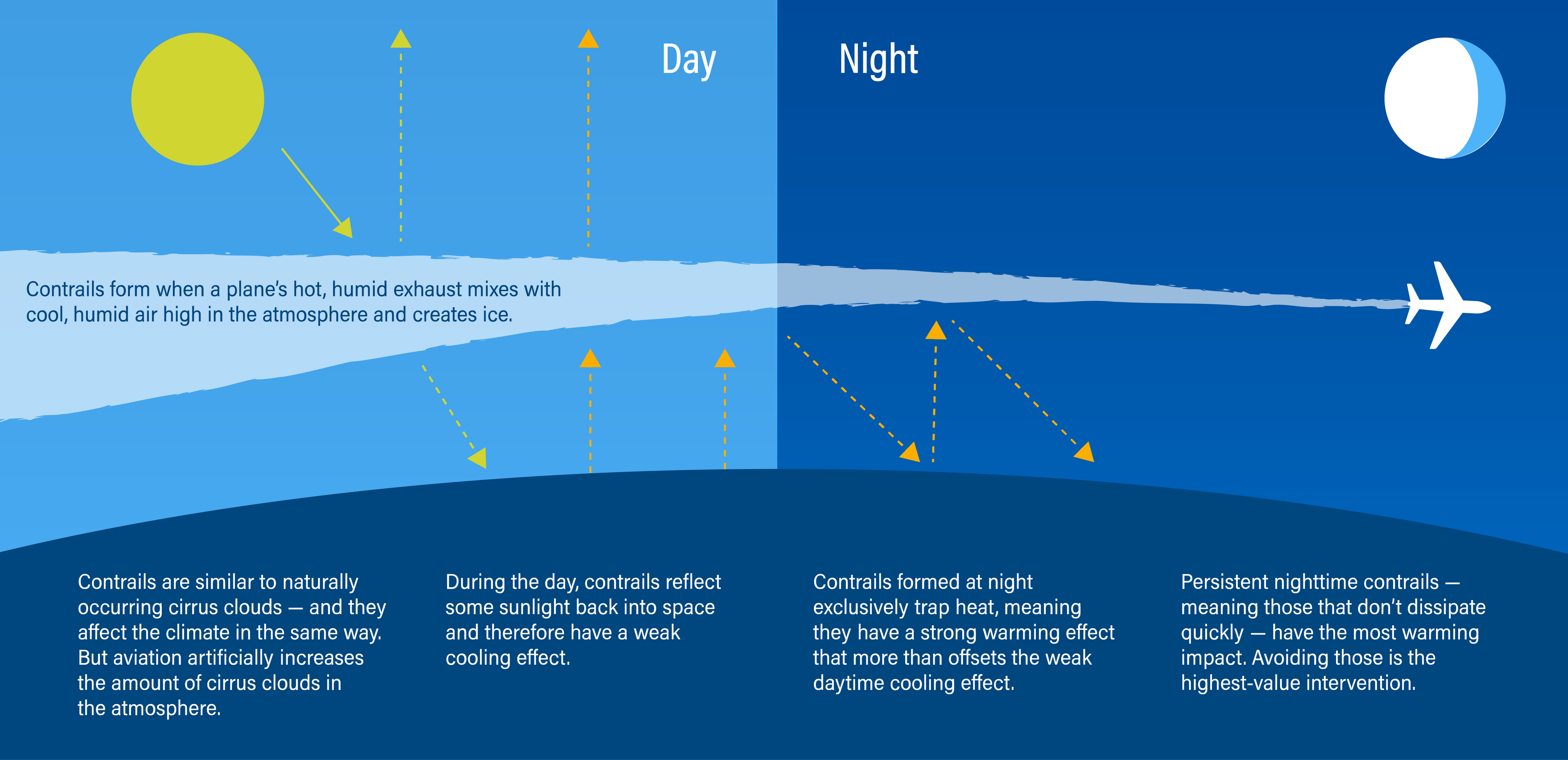
The warming impact of aviation contrails on the climate is estimated to be as significant, if not higher, than aviation’s CO₂ emissions. However, it is a very concentrated problem – less than 3% of global flights generated 80% of contrail warming in 2019.
A new study by Transport & Environment (T&E) has found that tweaking the flight plans of only a small number of flights to avoid contrails could reduce contrail warming by half. They found that contrail avoidance strategies targeting only the most warming flights are a “no-regret” solution.
A group of international scientists have also recently warned of the warming impact of contrails and risks of delaying action. In an open letter they have highlighted that addressing contrails is a no-regrets decision that will help slow climate change:
Recognising the impact of non-CO₂ effects, particularly contrails, on our warming climate and the urgent need for action, we, aviation and climate scientists, call upon global decision makers to implement solutions to tackle non-CO₂ effects of aviation on top of decarbonisation efforts.
At Safe Landing, we back these calls and also recognise contrail avoidance as our best opportunity to rapidly reduce the climate impact of aviation this decade, without flying less. Contrail modelling, prediction, measurement and mitigation will also likely increase aviation jobs. A win-win for the planet and for aviation workers.
Read our own briefing on aviation’s contrail problem here: https://safe-landing.org/contrails-blog
Targeted interventions
The T&E study shows that, for the small number of flights where contrail warming is significant, a large reduction in climate impact can be achieved be re-routing the flight via a minor flight path or altitude change:

We have known about the significant warming impact of aviation contrails since the 1990s, yet so far have not implemented any regulations, policies or practices to mitigate them. Our industry has so far blamed this delay on “uncertainties” in the science of estimating the exact warming impact of contrails. The claim is that mitigation actions such as changing altitude could require aircraft to burn additional fuel and produce additional CO₂ which could make global warming worse. However, we think is a very poor excuse for inaction – and the “uncertainty” should actually be a rallying-call for more urgent action to trial well-informed mitigation measures:
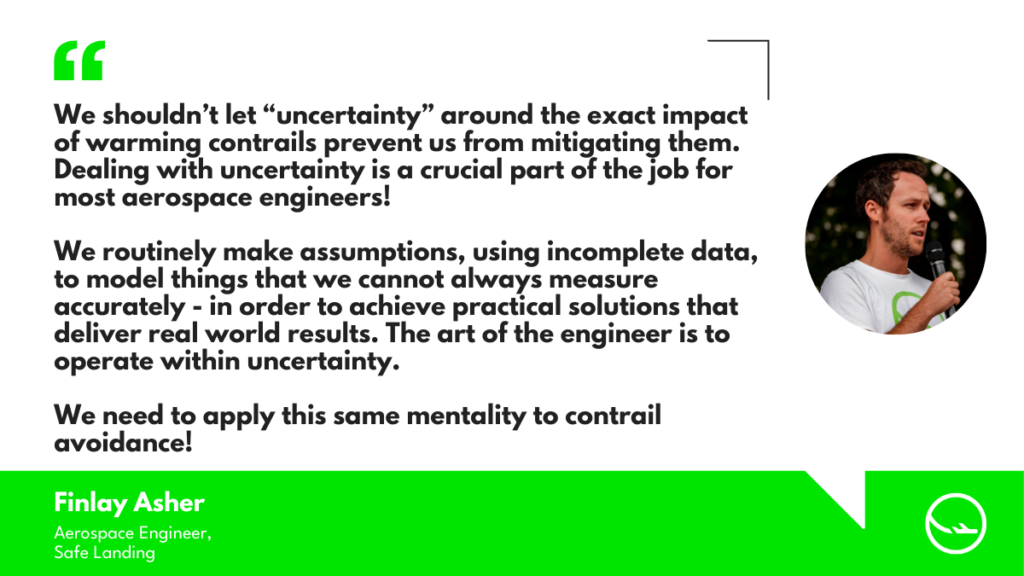
While there is a wide range of warming estimates for aviation contrails at a global scale – that range is from “high”, to “massive” or “gigantic”. In other words, we have a high confidence that aviation contrails cause a very significant level of global heating – we just cannot be accurate with the exact number. Furthermore, we have a good idea of which flights, in which areas of the world and at which time of day have a higher probability of generating warming contrails:

If we target these flights, and ignore the rest for now, we can be almost certain that contrail avoidance will be worth it.
No regrets
This chart from T&E shows that even if we use pessimistic assumptions for our ability to avoid contrails successfully without burning a lot of additional fuel, the overall climate impact (measured in tonnes of CO2 equivalent, or CO₂e) will still be significantly reduced:

This impact should also only improve with time as we refine our prediction modelling, avoidance and re-routing procedures:

Unpicking the ‘additional fuelburn’ issue
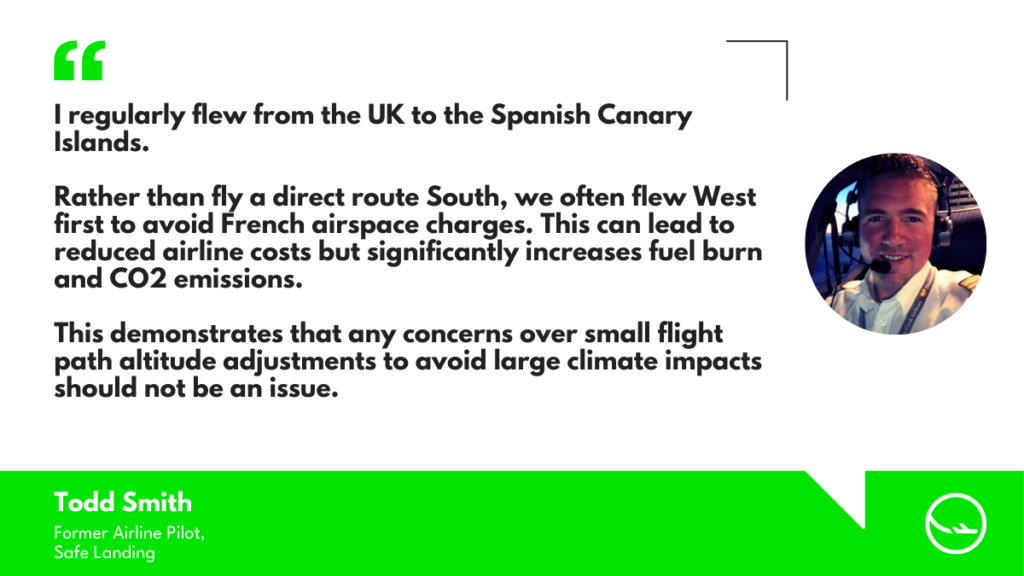
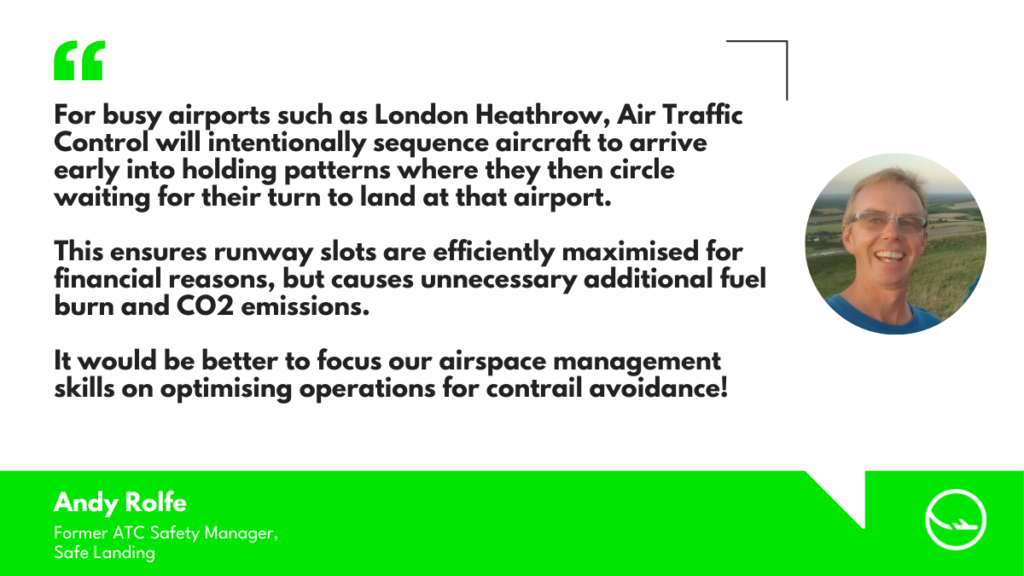
Many members of our global community are current or former airline, pilot or air traffic control workers. We have direct experience of airlines burning additional fuel for a variety of reasons (e.g. flying faster, ‘fuel tankering’, or avoiding an airspace charge) to reduce direct operating costs at the expense of an increased environmental impact. This makes it a bit hypocritical to claim we cannot afford to make small flight path adjustments and burn relatively small additional quantities of fuel in order to make large environmental improvements:

A low-cost solution
As an added bonus, contrail avoidance is as cheap as chips! Well at least, per air passenger, cheaper than an airport coffee:
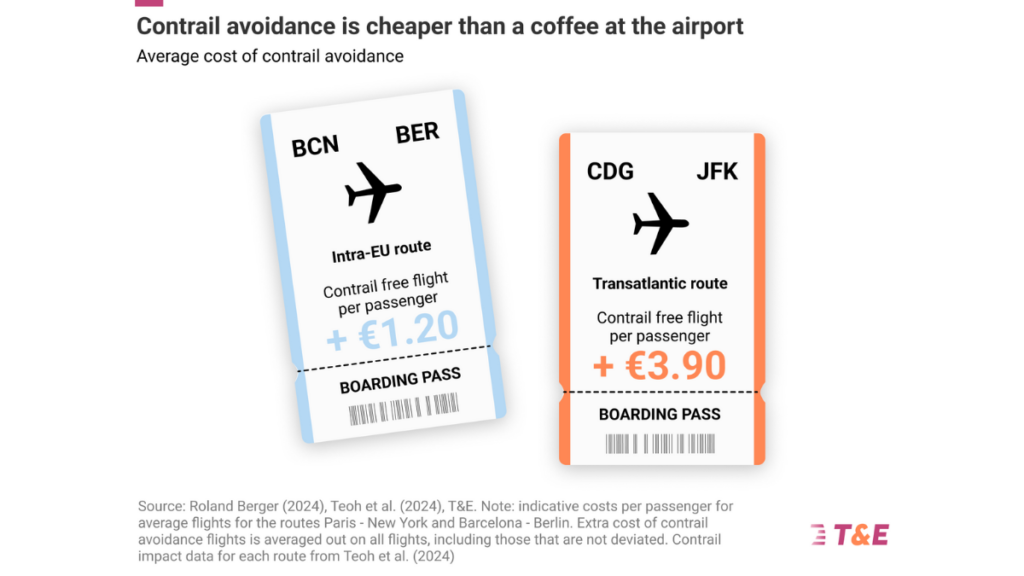
This makes it not only one of the fastest ways to reduce our impact on the climate, but also one of the lowest cost options. Compare it to any measure necessary to reduce the CO2 impact of aviation, such as alternative fuels, or negative emissions technologies such as Direct Air Capture (DAC) and the cost of abatement looks very small indeed:

The aviation worker perspective
Remember, these additional costs will result in more aviation activities and jobs for workers: from modelling, to measuring, to mitigating to verifying and improving. So we have no reason not to be supportive of these additional costs. It’s about time our industry started making use of our talents to properly address this issue!:
And it’s not just the Safe Landing community, international scientists and environmental organisations that are calling for urgent action on contrails; it’s also aviation-related unions. For example, the British Air Line Pilots Association (BALPA) has called on the UK Government to take rapid action.
What can you do?
Let’s push collectively for aviation contrail mitigation.
Let’s encourage those countries whose flights have a higher probability of producing warming contrails to take the lead.
If you’re part of a trade union, talk to us about how to raise this issue and put forward a motion in support of developing mitigation strategies.
If you’re an aviation worker, concerned about the climate, and the future of our industry – sign-up to Safe Landing to discuss how to do this most effectively!