
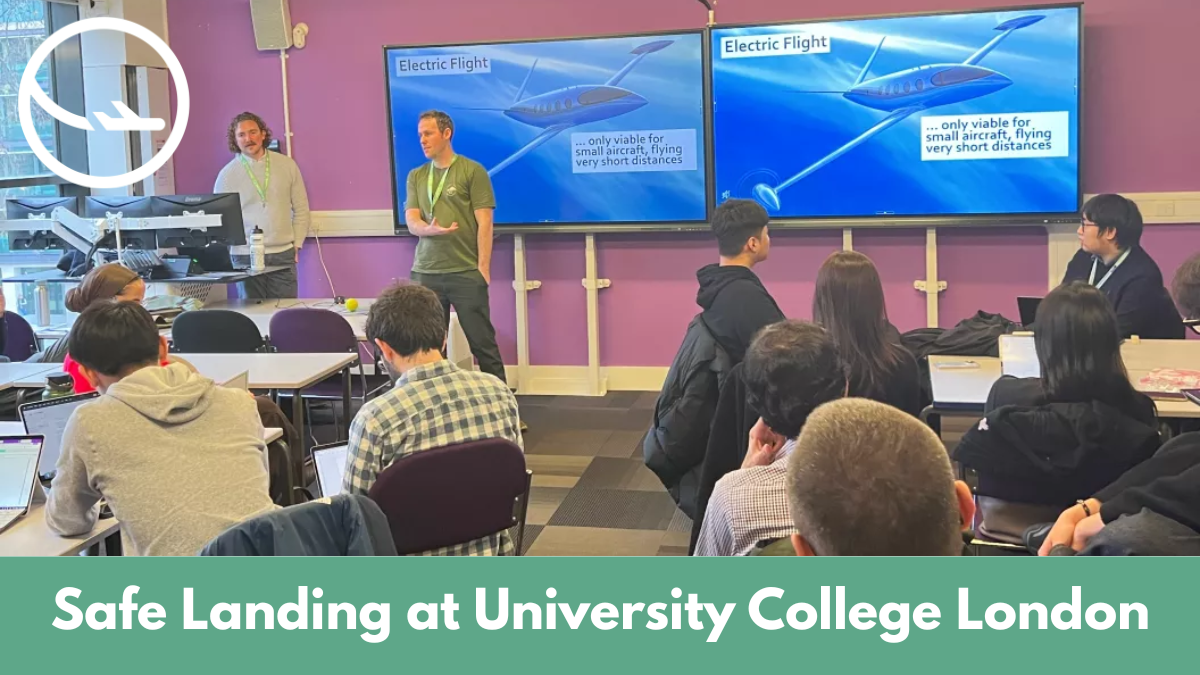
A University College London (UCL) module brought together students and Safe Landing to investigate the opportunities for net zero in the aviation sector, which is among the most difficult to decarbonise.
MSc students in UCL Civil, Environmental and Geomatic Engineering (CEGE) recently collaborated with Safe Landing, an organisation of current and former aviation professionals concerned about climate change, to critically analyse the UK government’s strategy for net zero aviation. The students worked in collaborative teams to find pathways for achieving net zero.
In 2022, the UK government published its Jet Zero Strategy, outlining how the aviation sector could meet net zero targets using scenario analysis. However, the strategy has been criticised by organisations such as Safe Landing, who argue that it relies on the unrealistic assumption that aviation can be both net zero and cheap, highlighting the high costs of alternative fuels and a technological transition.
Through their research, the MSc students found that the government’s plans for aviation passenger growth are at odds with net zero. According to the scenario analysis that was conducted by the students, technological progress alone is not sufficient to reach net zero by 2050, unless demand is constrained. This applies in particular to long haul flights, which contribute most towards aviation emissions.
Safe Landing want to preserve the ‘beauty of flying’ but within climate limits. Among its members are pilots who quit the industry, as featured in a documentary by The Guardian.
Finlay Asher, a former Rolls-Royce systems engineer who worked directly with the students, said:
“Students are the future of our industry. Their fresh minds can break the mould of old-school economic ideas and ways of delivering air travel. It was a real pleasure to collaborate with them as they assessed the UK Jet Zero Strategy and alternative options.”
Alberto Monterrubio Velardo, a student on the MSc Environmental Systems Engineering course, said:
“This module taught me a lot about the aviation industry, emission calculations, net-zero strategies and scenario modelling. However, the biggest lesson was to work in multi-disciplinary groups to integrate previous knowledge and collaborate on an open-ended problem from an unfamiliar topic.”
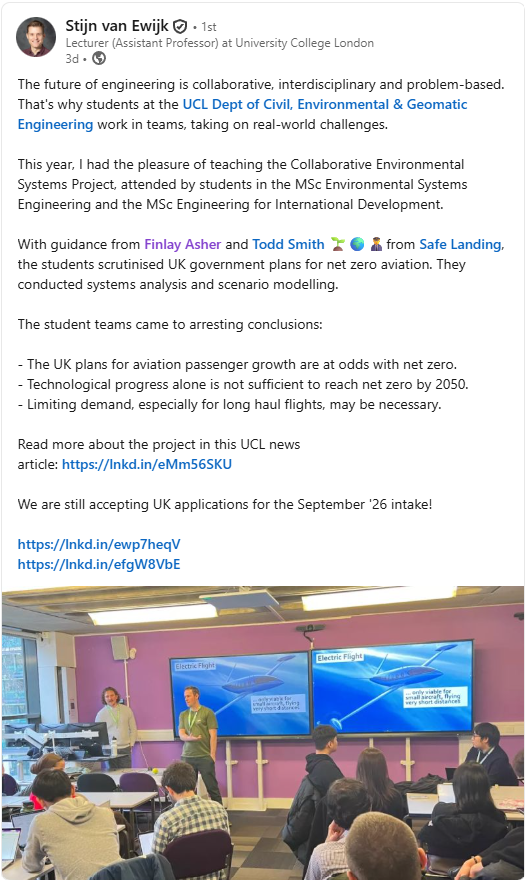
Thanks to Stijn van Ewijk for inviting us to engage with his class!
If you’re in academia/education, or a student yourself, and would like to arrange a Safe Landing talk at your institution – we do this regularly and are more than happy to consider any requests – please reach out to us on: info@safe-landing.org to discuss this!