

The Farnborough Airshow is taking place from 22-26th July 2024 and will be this year’s biggest event in the aviation calendar. The airshow is used by aerospace companies to show off their aircraft technology, and large aircraft orders from airlines tend to be finalised and announced during the week.
The airshow will take place at Farnborough International Airport near London, the UK’s busiest private jet airport. It is also a location where Safe Landing has actively opposed expansion of private jet operations. Meanwhile, so far this year we’ve already experienced Dubai Airport going underwater, intense ‘unprecedented flooding‘ in the US, and severe heatwaves across Asia.
Aviation companies will be out in force at Farnborough, showcasing the latest technological innovations, with aerospace manufacturers gearing up for massive sales to airlines who are predicting a post-pandemic surge in air traffic.
However, with a rapidly accelerating climate crisis, is now really a sensible time for airlines to place massive aircraft orders?
Let’s take a look…
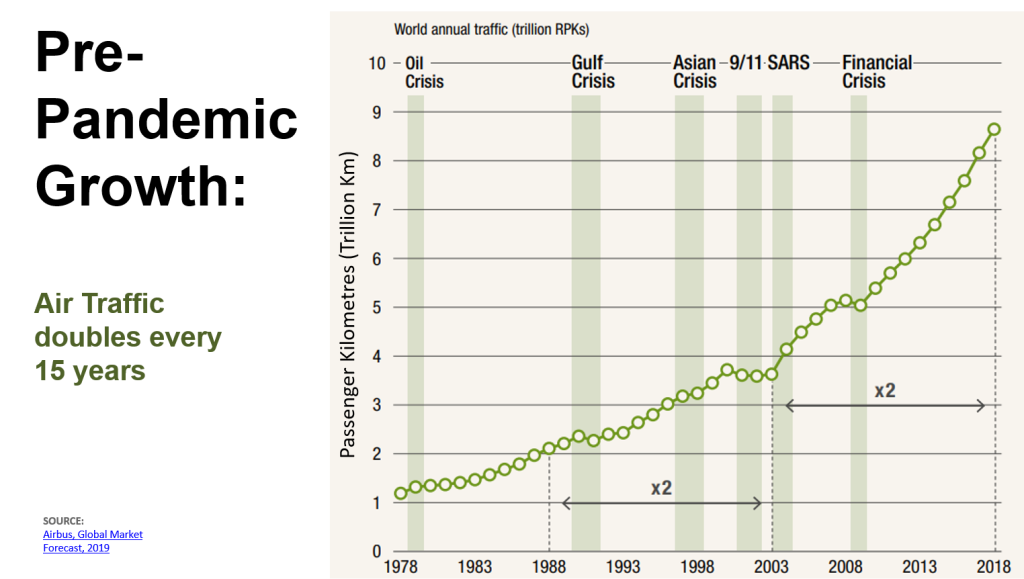
Historic Air Traffic Growth
Historically, aircraft sales and air traffic have approximately doubled every 15 years.
Aviation Emissions Growth
Despite all of our brilliant aircraft technology and airline operational efficiency improvements over the past 50 years, this massive air traffic growth has wiped out any emissions reductions, and we’ve actually seen a massive increase in total emissions from global aviation:

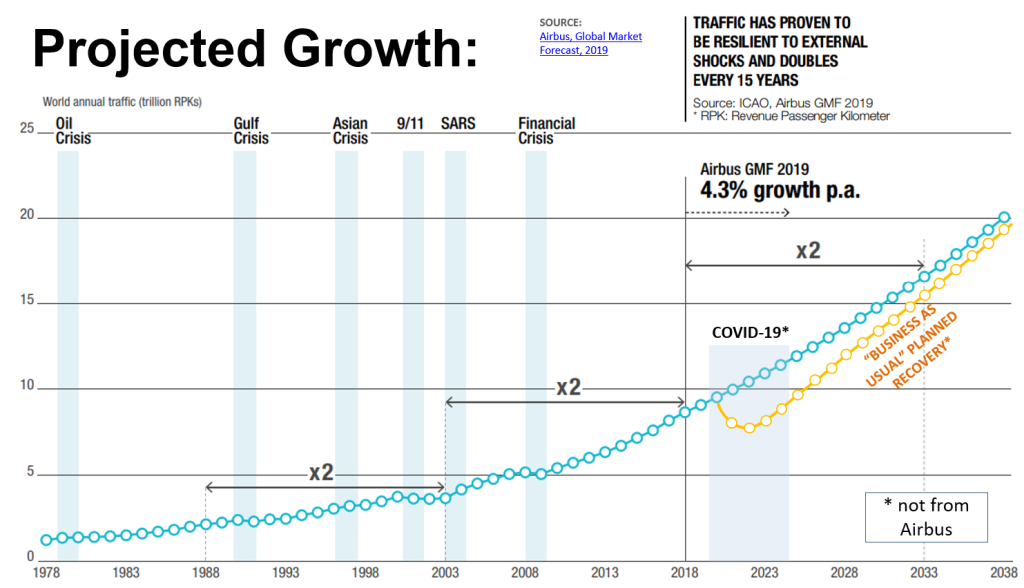
Future Air Traffic Growth
Following the air traffic dip during the Covid-19 pandemic, the major aerospace manufacturers, Airbus and Boeing, are predicting a return to pre-pandemic levels of growth. This would lead to a doubling of air traffic, again, over about the next 15 years:
Climate Crisis Crash
Many more factories, many more aircraft, many more airports, many more flights, many more aviation jobs right?
In the very immediate short-term, i.e. the next few years, yes.
However, we have an even bigger threat than another global health pandemic looming over us. We’re are on track to blow our global carbon budget for 1.5°C of global warming within the next 5-10 years:
In this now highly probably scenario, with the planet facing irreversible climate change, we run an increasing risk of runaway global warming, climate breakdown and ecological collapse. It’s highly likely that we’ll see increased heatwaves, crop failure, and water and food scarcity in many populated regions around the world. This will probably lead to drought, famine and mass migration. A prolonged global financial crisis will no doubt result. Read our detailed workshop analysis of these risks here.
With the carbon budget blown, it will become imperative to reign in emissions. With fossil fuel subsidies removed, and their production ramping down rapidly, and Negative Emissions Technologies being mandated: kerosene prices are likely to sky rocket. Alternative energy sources (such as biomass and renewable electricity) will also remain scarce – forcing their prices up.
If despite all of this (the potential moral calamity of hundreds of millions of displaced climate refugees, deaths caused by heatwaves, economic depression, intense competition over scarce resources and rising energy prices), people still continue to fly more: it’s likely that governments will place enforced limits on flying and other high carbon or energy-intensive activities.
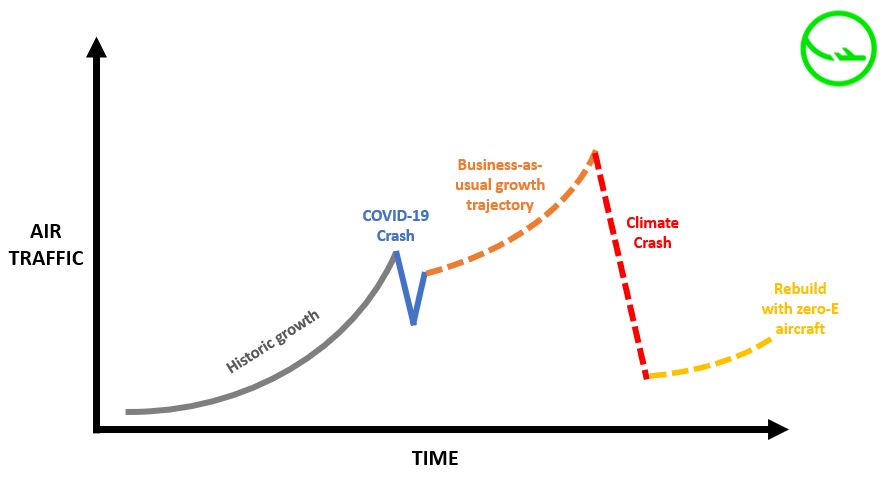
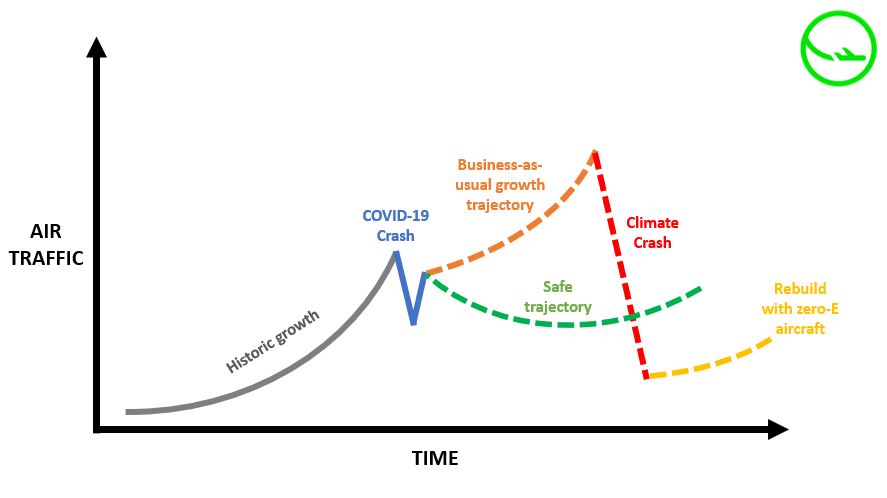
This could lead to a “climate crash” within the aviation sector:

Stranded assets from building the wrong things
One of our expectations is that business-as-usual aviation expansion today will lead to stranded assets for investors due to overcapacity of factories, airlines and airports for the number of flights that can be taken using the existing fleet of aircraft.
A recent report from the ICCT showed that projected lifetime emissions from new aircraft deliveries will consume the remainder of a net-zero carbon budget by about 2035 (between 2032 and 2037):

Future ‘zero emission’ aircraft configurations, e.g. electric or hydrogen, are likely to be significantly different size, shape, range and passenger carrying capacity. This will require very different airport terminal, gate and runway layouts, as well as alternative airline operations and flight routes. So the chances are that we’re also currently building the wrong stuff.
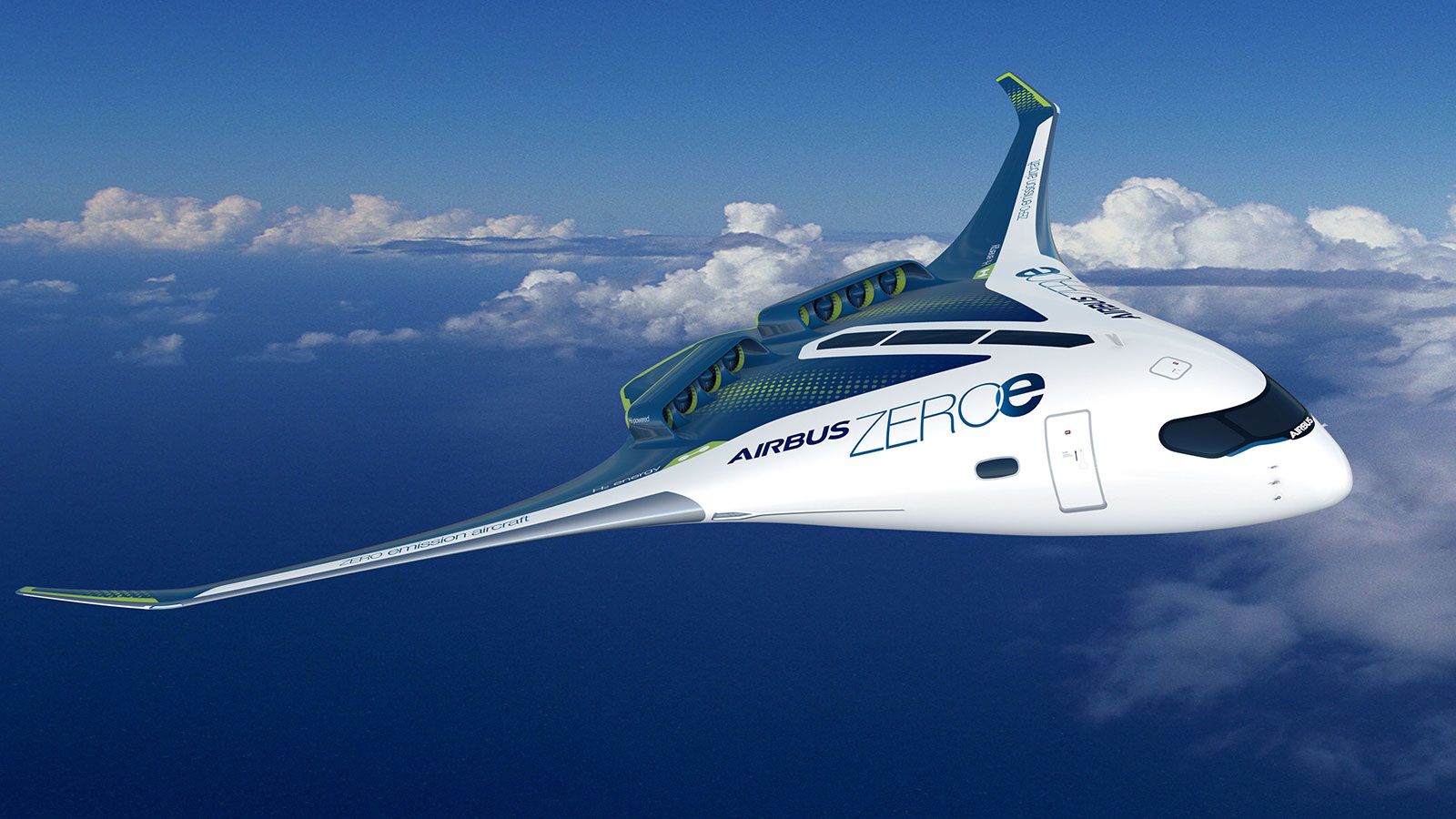
It’s worth noting that the order books being filled at the Farnborough Air Show this week feature essentially none of these aircraft – they have literally not been designed, developed and certified for operation yet.
We might be able to rebuild our fleet, with ‘zero emissions’ aircraft in the future, if our planet remains livable, but this will likely be following a prolonged ‘climate crash’ for the industry:
“SAF” won’t cut it
You might think none of this matters because the industry is pinning it’s strategy on so-called “Sustainable Aviation Fuels” or “SAF” which can be a drop-in low-carbon replacement for fossil jet fuel (kerosene).
However, the CEO of Qatar Airways, Akbar Al Baker, has described the airline industry’s emissions goals as a “PR exercise,” saying aviation is on track to miss its target to achieve net zero status in 2050. “Let us not fool ourselves,” Al Baker told CNN. “We will not even reach the targets we have for 2030, I assure you. Because there is not enough raw material to get the volumes of SAF [sustainable aviation fuel].”
A recent scientific paper has also concluded that: “The scaling up of SAF to not only maintain but grow global aviation is problematic as it competes for land needed for nature-based carbon removal, clean energy that could more effectively decarbonise other sectors, and captured CO2 to be stored permanently. As such, SAF production undermines global goals of limiting warming to 1.5 °C; a conflict that is neither recognised in the roadmaps nor in the public debate.”
Read our detailed Safe Landing position on so-called “SAF” here: https://safe-landing.org/saf-position
Aviation has been historically vulnerable to crisis
If the logic above doesn’t convince you that we’re heading for a ‘climate crash’ of the aviation industry – maybe you don’t even believe that climate change is real or a big deal – then perhaps you might acknowledge a whole host of other risks facing the aviation industry?
The Covid-19 global health pandemic led to a sudden reduction in air traffic as governments around the world imposed travel restrictions in an attempt to limit the spread of the virus. This sudden contraction of the industry was unplanned and led to widespread job losses. Aviation companies scrambled to save costs, despite financial support provided from governments.
The aviation industry has historically faced an “unplanned” crisis like this roughly once per decade: with the September 11 security crisis in 2001, the financial crisis in 2008 and the Covid-19 health crisis in 2020.
These crises have often been predicted in advance, yet the risks have been played down by aviation companies within corporate risk registers and robust mitigations have been neglected in favour of “planning for the best”, crossing our fingers, and hoping that severe risks never materialise.
In all instances, business leaders have faced no repercussions, while aviation workers have suffered all of the consequences when the crises do hit. This has been through voluntary or forced redundancies, erosion of employment terms & conditions, and in some cases the “fire and rehire” practice where employers take advantage of the situation by firing workers then re-hiring them on worse terms & conditions.
The potential for future crises within aviation
We are aware of the these other (not-exhaustive) list of risks:
- The nature of aviation means that it will always be susceptible to security risks both from travellers themselves and the outbreak of conflict which will limit travel to any affected regions. There are numerous factors which are likely to exacerbate conflict in the coming years as a growing population contends with depleting resources.
- Aviation is also susceptible to global health pandemics as governments can attempt to slow the spread of transmissible viruses by restricting travel. We know that the probability of such health pandemics is increasing with time and, with the right conditions, the next pandemic could well be more severe than Covid-19.
- Aviation is also very sensitive to global economics, and therefore to financial crises. These could happen at any time, but face particular risks around the cost of energy: as energy demand continues to grow, yet the supply of fossil fuels must be rapidly reduced in order to meet global climate targets. This is likely to result in higher costs of living, squeezed financial budgets, and increased jet fuel costs which will impact the ability of many to fly.
“Covid-19 is like a canary in a coal mine”, said Jonathan Counsell, Group Head of Sustainability for IAG and Chair of IATA Sustainability & Environment Advisory Council, “it’s a demonstration of the scale of disruption that can be caused by naturally-occurring events – and a warning about the even bigger threat posed by climate change.”

Even Heathrow Airport has stated (pg. 6) that: “Climate is an existential threat to aviation, to us all personally and it must be addressed. […] aviation needs to reach net zero emissions by 2050. That may seem like a long time, but if the substantive changes that are needed have not been made by 2030, the industry won’t be on track for its 2050 goal. This is the decade to make a difference.”
So if senior figures in the industry are making these conclusions, then as aviation workers shouldn’t we also think for ourselves?
Limiting air traffic is necessary but being ignored
We recently delivered a ‘Lunch & Learn’ on the topic of aviation industry growth which can be viewed here:
The Intergovernmental Panel on Climate Change (IPCC), the International Energy Agency (IEA) and the UK Climate Change Committee (CCC), have all recommended policies which encourage behaviour change and limit air traffic growth. However, the industry is ignoring this and is planning to more than double global air traffic by 2040. We think this is likely to fly us towards a major industry crash.
We recognise that business leaders are often incentivised to deliver short-term results (e.g. quarterly profits and a rising share price) on time-scales at maximum of a few years, rather than take on costs in the short-term in order to ensure long-term sector stability. They won’t be around when the proverbial “s**t hits the turbofan” with the climate crisis.
On the other hand, most workers will hope to have a safe and secure job that continues for decades. We’ll benefit from short-term costs such as the work required to transform our factories, aircraft, airlines and airports. There’ll also be job creation from re-designing aviation for a more distributed, energy efficient and equitable air transport system where people fly less frequently, less far and less fast in smaller, shorter range zero emissions aircraft.
However, workers will be the ones who will bear the brunt of any industry crisis (as they did during Covid) once aviation companies realise they have built in overcapacity with business-as-usual expansion.

An alternative narrative: “Towards a Safe Landing”
Let’s change the narrative by showing it’s in our self-interest as workers to take rapid climate action and limit the growth of air traffic in the short-term for the best interests of our industry and our employment. This tackles the current dominant narrative that environmental action will be at the detriment to jobs.
We can present positive visions of the future for air travel that are filled with employment. There’s a massive opportunity for jobs creation within the aviation industry via technology development e.g of low-carbon planes and associated airports – it will only take money and political will.
We could design an air transport system for optimum energy efficiency (which optimises for minimum fuel burn, rather than minimum journey time and staff costs etc). This transport network could be more distributed, could improve equality of access to air travel across the world, and could create more jobs – even within the constraints of limiting overall air traffic and rapidly reducing aviation emissions.
Flying in moderation
At Safe Landing we believe that flying less this decade will buy us time to transform aviation. It will also help preserve the planet and tourist destinations for future generations and provide us with the best chance of being able to continue to fly into the future. Surely this is the safest trajectory for people, planet and workers?
We should recognise that very few aerospace, airline or airport business leaders will be willing to accept this reality, although Rome Airport’s CEO is a notable exception. They know that for their company to voluntarily accept limits on growth will put them at a competitive disadvantage against other companies.
The need for agency amongst aviation workers
This is why as aviation workers, we need to recognise the approaching cliff edge and the systemic issue of business leaders who want to cover their eyes and hope for the best, knowing they will likely have moved on by the time that the impact hits.
It’s on us to recognise our own self-interest of changing direction. We can be at the controls when navigating a sustainable future for the industry. But we need to influence politicians, governments and world leaders to step in and properly regulate our entire industry before it becomes to late:

Join us at Safe Landing, to help navigate a sustainable future for aviation workers.