

On 28th November 2023, Virgin Atlantic will be flying from London to New York on an aircraft powered 100% by so-called ‘Sustainable Aviation Fuel’.
We expect much fanfare around the event: no doubt aviation industry public relations, media and marketing teams will be having a field day. Watch out for news stories gushing over how “guilt free flying” will soon be here. The aviation decarbonisation challenge is solved. “SAF”, the magic golden bullet of aviation, will smash through any climate concerns related to flying…
With our aviation leaders and many politicians presenting SAF as the answer to the decarbonisation challenge, and with this flight poised to convince the media and general public that our industry is it seemed a good moment to take a look at what Virgin Atlantic won’t be telling you about their flight…
Firstly, take a look at this video: proof of how SAF will be marketed in the coming years as the golden bullet!
The cost of SAF
Alongside the back-patting and trumpet-blowing, there will be a concerted effort by our industry to lobby for huge financial subsidies and incentives to scale the supply of SAF.
The costs involved are eye-watering. Price projections expect SAF to be anywhere between 2 to 10 times the cost of conventional aviation fuel (kerosene). IATA, the industry lobby group representing airlines globally, expects the cumulative costs of decarbonising aviation between now and 2050 to be $5 trillion, with most of that going towards “SAF”.
HOW SUSTAINABLE IS “SAF”?
Is “SAF” production an effective way to protect the environment, provide return on investment, and create secure aviation worker employment?
On all three counts, we don’t think so. Read our full explanation of this in our response to the UK Government’s SAF Mandate Consultation. In this blog post, we will unpack some of the high-level points.
WHAT IS “SAF”?
Alternative jet fuels or so-called “Sustainable Aviation Fuels” (SAF) are liquid hydrocarbon fuels that can be used with existing aircraft in place of conventional aviation fuel (kerosene) produced from fossil fuels.
The industry’s premise of the sustainability of these fuels is to create the fuel using CO2 taken from the atmosphere, rather than using fossil fuels extracted from deep underground which emit additional CO2 to the atmosphere when burned. The argument is that blending these fuels with fossil fuels would therefore reduce emissions.
These alternative jet fuels can be broadly categorised into two varieties:
- Biofuels – produced from biomass sources
- Electro fuels (e-fuels) – produced from electricity
Note: there are other alternative fossil fuel substitutes such as battery-electric or hydrogen powered aircraft. However, these require new alternative aircraft configurations to be developed, then certified, and we’re still decades away from having long-range, high-passenger capacity airliners powered by these forms of energy. As such, we’ll only focus on liquid jet fuels here.
BIOFUELS
Biofuel production can use various sources of biomass as an input. First generation biofuels use agricultural crops. Second generation biofuels aspire to use industrial, agricultural, municipal or household waste, such as: used cooking oil, animal fat, corn husks, farm/forestry waste, or food waste.
First Generation Biofuels
Aviation does not rule out the use of first generation biofuels from crops, which are proven to cause very serious environmental and social impacts such as biodiversity loss, rising food prices and water scarcity.
Burning first generation biofuels in many cases can be even worse than burning fossil fuels:

This is due to indirect land use change emissions, which cannot be avoided on the scale required to for aviation. For example, a recent study by the Royal Society, found that the UK would have to devote half its farmland to make enough aviation fuel to meet current UK demand:

Meeting even a fraction of this with crop-based fuels would create significant additional pressures on land and would be highly likely to lead to additional deforestation, loss of wildlife, peat lands and carbon sinks.
Second Generation Biofuels
Second generation biofuels aspire to use industrial, agricultural, municipal or household waste, such as: used cooking oil, animal fat, corn husks, forest resources, farm or food waste.
There is a very limited quantity of “sustainable waste” available globally for second generation biofuels:

From the Climate Change Committee (CCC) “Biomass in a Low-Carbon Economy” (2018), pg 114
It can be seen that aviation biofuel demand alone could consume the entirety of the highest end estimate of global biomass supply. What’s more, other uses in other sectors such as bioplastics, and in particular, Bioenergy Carbon Capture & Storage (BECCS) could consume more than the entire supply. This shortfall between the estimates of total bioenergy available and total bioenergy demand is also illustrated in this diagram from Shell in their “Decarbonising Aviation: Cleared for Take-Off” report, page 74:

It can be seen that the Chemicals sector alone may consume most bioenergy available.
Industry insiders are well aware or the problem with resource availability and competition. An EU report (contributed to by Airbus, Boeing, BP, Shell, and easyJet) in 2020 stated that “biofuels’ reliance on feedstock, changes in land use, high water use, and/or monoculture (i.e., the production of a single crop) means that the aviation industry will be competing with other interests that need the feedstock for other purposes”.
The problem for aviation is that this biomass can be used more efficiently and environmentally to decarbonise other sectors. For instance, biomass waste from farms, forestry and households can be decomposed via anaerobic digestion into fertiliser/compost and the nutrients recycled for growing food. Burning these feedstocks as fuel would throw these nutrients away, and mean that additional fossil fuel based fertilisers would be produced – increasing overall emissions.
The Virgin Atlantic flight will most likely be powered by “SAF” that has been produced, via the “HEFA” fuel pathway, from either used cooking oil or animal fat. This is the only aviation biofuel production process that has been demonstrated at commercial scale. It is far easier to collect, transport and process waste fat/oil into a fuel, than any other feedstock. This is because of its energy density and similarity of the feedstock input to the desired fuel output. The same isn’t true of other biomass waste feedstocks such as forestry twigs, branches, or leaves and farm straw, stalks or husks – these have a low energy density and require excessive additional energy to convert into a fuel.
So while flying this 100% SAF-powered flight might sound like an exciting breakthrough, it is limited in practice. Best estimates are that the UK and Europe could only meet about 2% of its existing jet fuel use from domestic waste oil/fat supply, without diverting feedstock from other sectors or importing excessive amounts of waste oil/fat from abroad with higher transport emissions and a high risk of fraud.
E-Fuels
When raising issues of sustainable biomass resource availability within the aviation industry, there is a tendency to point to electro-fuels (e-fuels) instead.
These can be produced by combining hydrogen with carbon to create a liquid hydrocarbon. In order to minimise emissions, hydrogen must be extracted from water by electrolysis using renewable energy; and carbon must be extracted from the air using a process called ‘Direct Air Capture’ (DAC). These can then be combined, to form a hydrocarbon fuel using Fischer-Tropsch (FT) synthesis. These processes must also be powered by renewable energy:
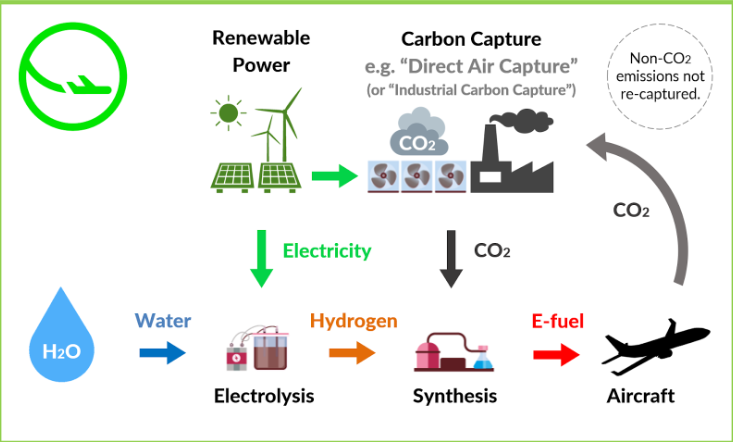
The problem with e-fuels is the inefficiency of each of these processes, which combine to produce a massive overall power-to-liquid energy inefficiency – where only about 10% of the initial renewable energy input is converted to thrust to power the aircraft.
Using renewable electricity to make e-fuel therefore looks like a crazy idea because energy requirements would be huge, whereas renewable electricity is crucially needed to decarbonise the global economy and can be used with a far higher efficiency in most other applications. See this graph from the CCC “electricity generation” report, page 11:
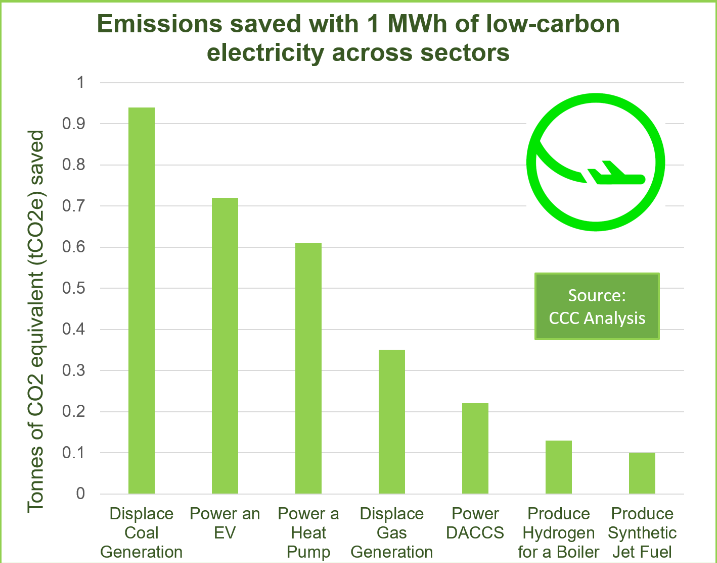
The CCC state on page 10 of the same report:
“Given potential limits to the pace of deployment of low-carbon capacity, it will be important to focus on sectors which have the most efficient use of low-carbon electricity.”
“Across our scenarios new demands therefore come primarily from the electrification of transport, heat, and industry. Hydrogen production, Direct Air Capture, and synthetic fuels are relatively inefficient uses of electricity and should be lower priority than direct use of electricity for decarbonisation.”
So what should we do? What will benefit workers and the long term future of aviation?
Steering back to our response to the second UK Government SAF Mandate Consultation – read our full submission here – we believe the UK government should be very wary of press stunts like the one we’re about to see Virgin undertake.
We advocate for the UK Government aviation fuel policy to involve:
- A focus on capping and reducing total jet fuel consumption as a priority, in order to drive down fossil jet fuel use. Any proposed “SAF” mandate is of secondary importance to this.
- Applying an emissions price to all aviation emissions in order to raise revenue for loss & damage funds and cross-economy decarbonisation.
- Performing a cross-economy assessment and prioritisation of available non-fossil fuel feedstocks, i.e. biomass and renewable energy, before assuming any for aviation.
- Prioritising non-fossil fuel feedstocks for applications which produce the greatest emissions savings, social utility, and distributed benefits across the population.
We conclude that the UK Government should therefore:
- Introduce a carbon budget for UK aviation consistent with 1.5°C and allocate that budget.
- Perform a cross-economy assessment of available non-fossil fuel feedstocks and allocate.
- Remove financial support for all aviation biofuels and remove biofuel ‘SAF’ mandate targets.
- Prioritise biomass for other uses: mostly fertiliser production, heating, and Bioenergy Carbon Capture and Storage (BECCS) plants. Prioritise waste oil/fat for ‘HVO’ biodiesel production, with relatively small quantities of ‘HEFA’ biofuel co-produced during this process.
- Remove financial support for electro-fuel (e-fuel) and e-fuel mandate targets in the near-term.
- Prioritise renewable electricity for other uses: mostly grid, building and ground transport decarbonisation.
- Focus financial support on grid decarbonisation, Green Hydrogen (H2) production and Direct Air Capture (DAC). Prioritise Green H2 produced for displacing Grey H2 and within aviation for hydrotreating kerosene. Prioritise DAC for carbon capture and storage (DACCS).
- Minimise fuel supply chains in order to reduce transport emissions of the feedstock and fuel. This will mean primarily utilising domestic feedstock supplies