What needs to happen to get flights on track for the climate?
There isn’t any way to fly without producing a lot of emissions which harm our climate. Yet the UK Government’s plans to tackle aviation emissions by 2030 doesn’t seek to reduce flights at all. Safe Landing have been critical of the UK’s ‘Jet Zero’ Strategy, and have responded to several consultations detailing our concerns: https://safe-landing.org/uk-jet-zero
Instead, their strategy to reduce carbon emissions from flying relies entirely on technological developments and there are huge problems with these; new types of planes don’t exist yet, alternative types of fuels could cause more problems than they solve, and carbon reduction methods such as offsetting don’t actually work.
Possible, is a UK-based climate-action charity, were sceptical that the government’s strategy would do what it claimed. So they commissioned experts at respected think-tank Chatham House to calculate whether the UK Government’s plans are realistic, and, if not, what more we need to do as a country by 2030 to bring down aviation emissions to a safe level by 2050.
They also commissioned Finlay Asher to provide feedback on the analysis process. Finlay is an aerospace engineer and co-founder of Safe Landing.
Read the full report here: https://www.chathamhouse.org/2023/11/net-zero-and-role-aviation-industry
Report Background
With growing uncertainty over the approach to net zero, the airline industry is struggling to find a sustainable way of reducing its carbon emissions. Global efforts to stay within the 1.5°C temperature target of the Paris Agreement are off-track, and extreme weather events are more common than ever. While the aviation sector is a critical contributor to the global economy and provides important benefits enabling travel around the world, the sector is notoriously difficult to decarbonise.
Most supply-side options for reducing aviation carbon emissions – such as zero-emissions aircraft and sustainable aviation fuels – are yet to be scaled and are still at the R&D phase. In the context of dwindling carbon budgets, this paper assesses the possibility of managing the demand for flights in order to set the sector on an achievable path for reaching net zero.
The model developed for this paper generates different scenarios that consider the main supply-side decarbonization solutions. The assessment notes the ‘acceptable’ level of aviation demand under each scenario to remain within carbon budgets. The model demonstrates that acting prudently, and reducing demand for flights in the short term, would offer the best chance of enabling the sector to play its role in achieving net zero.
Report Findings
The researchers found that:
-
The measures that the government plans to rely on to bring aviation emissions down will not achieve their carbon reduction targets. There are many barriers to these technologies: they are decades away from being ready, and will not result in the reductions in carbon emissions that the government claims.
-
Because of this, the total number of flights needs to reduce, in order to cut emissions and protect the climate. As a country we need to fly less far and less frequently for the rest of this decade.
-
To achieve the reduction in carbon emissions set out in the government’s plan, we will need to reduce flying by 36% by 2030 (compared to 2019 levels).
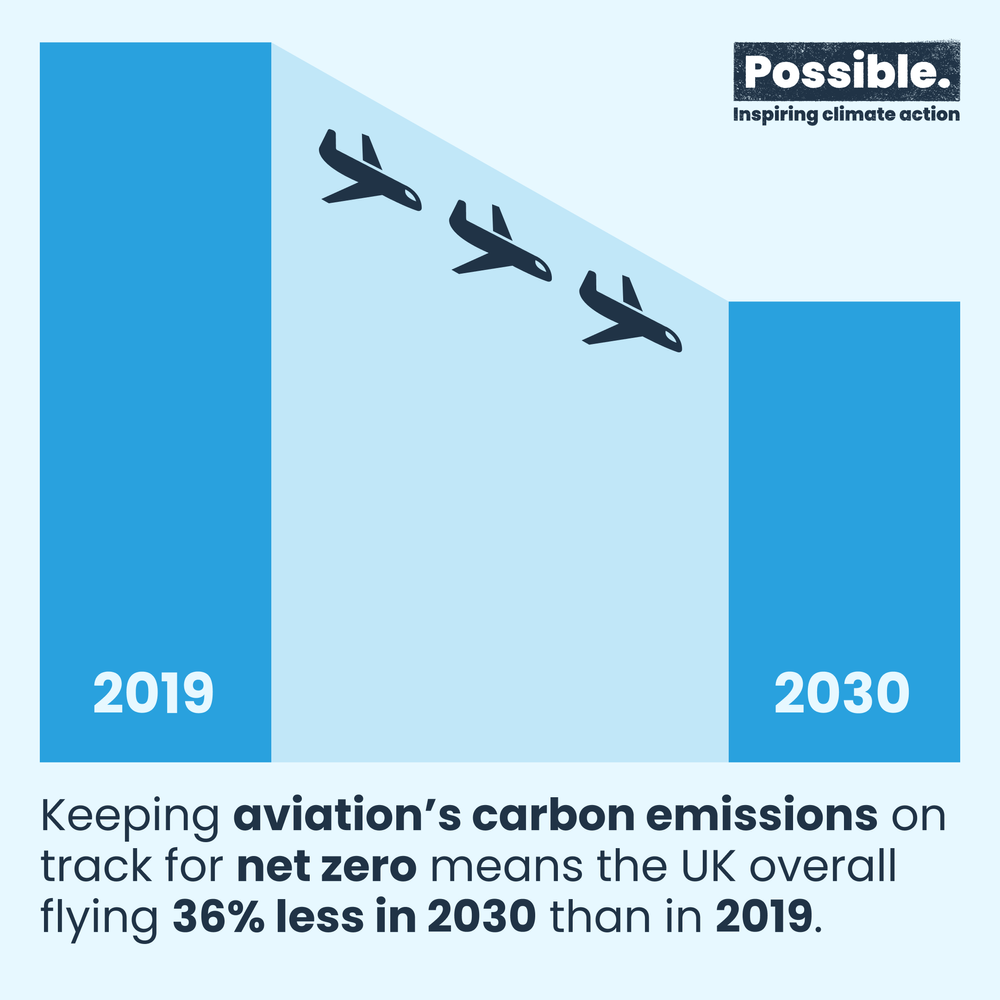
What does a 36% reduction in flights look like?
-
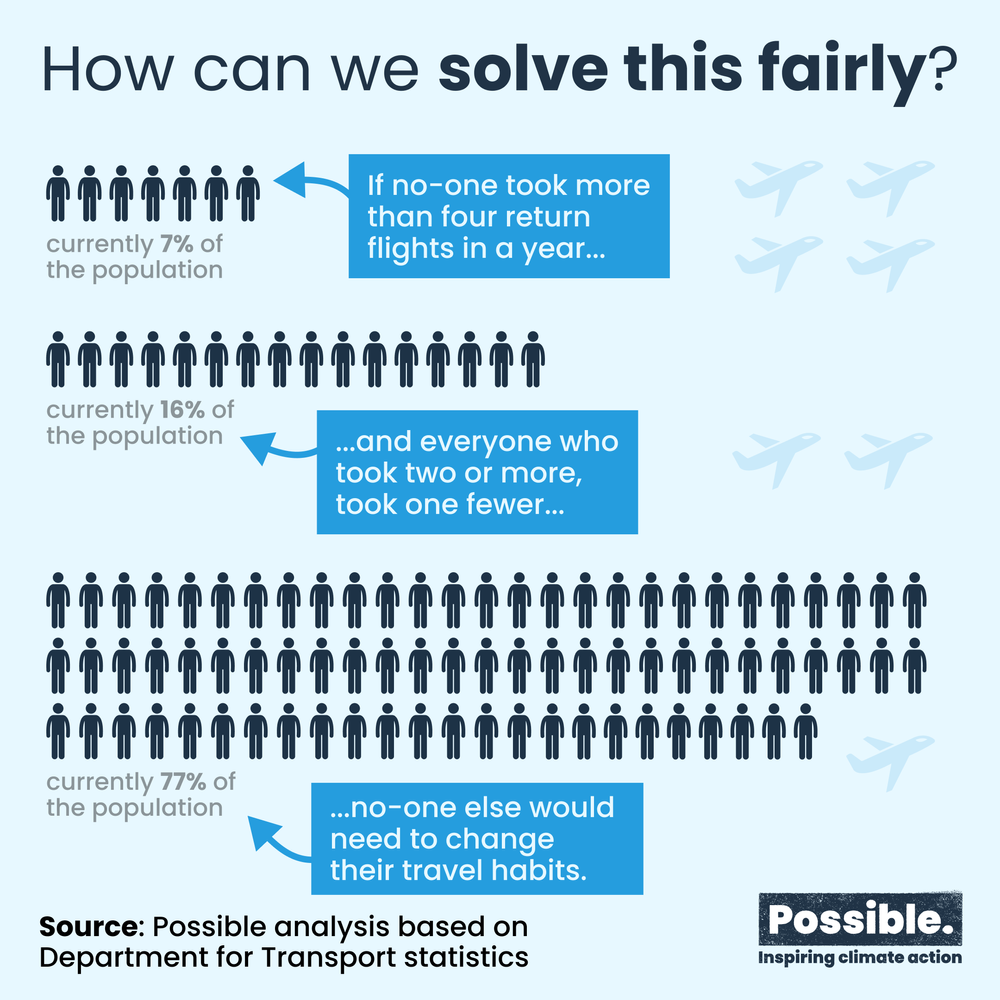
Because of this unequal distribution of flights among the UK population* it would be possible to achieve large reductions in carbon emissions without affecting the travel habits of most people, who already fly rarely (if ever).
-
For example, to hit the 36% reduction target, all that would be needed would be for the 23% of people who currently take more than one return flight per year to reduce their flying by one trip, and for no one to take more than four return flights per year. The remaining 77% of us, who already fly once or less each year, wouldn’t need to change our travel habits.
-
This reduction in flying by the small group of people who fly most is an incredibly reasonable, moderate level of behaviour change in order to reach the government’s carbon reduction targets for aviation
But if we’re serious about the climate crisis, we need go further:
-
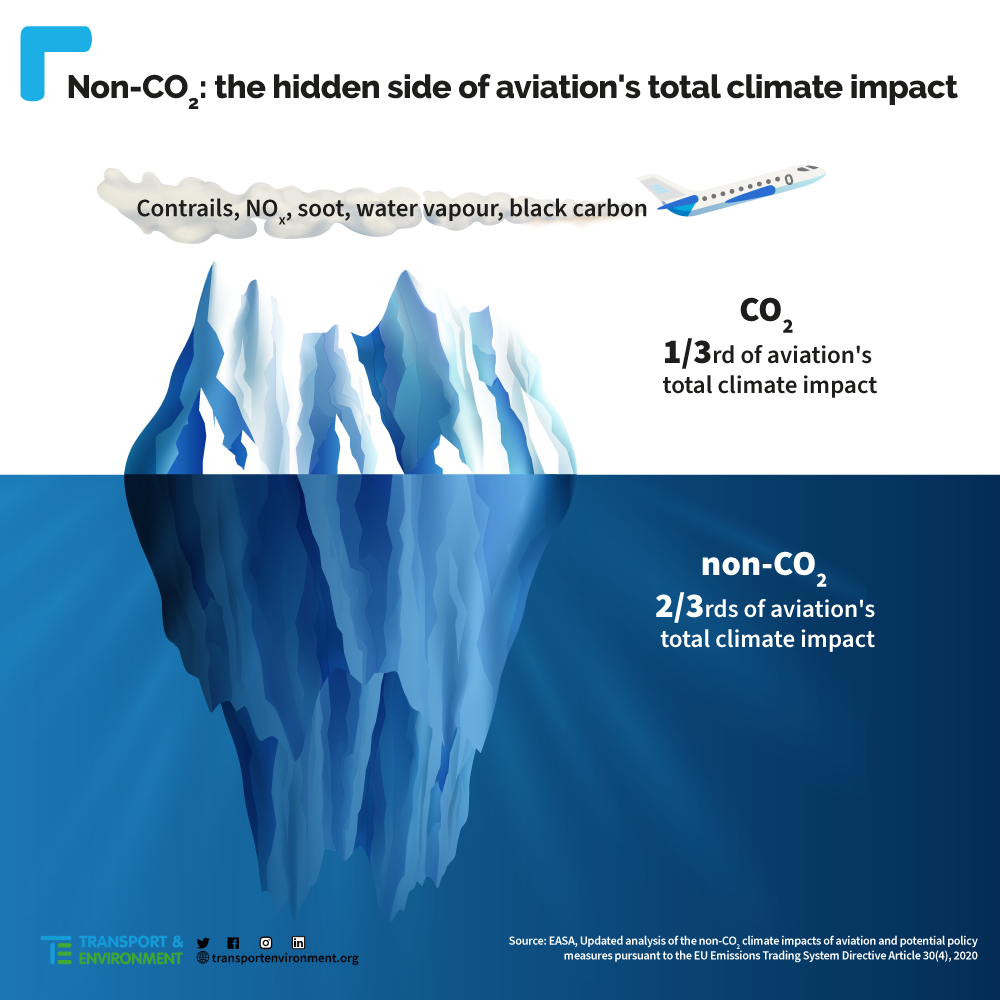
At the moment, the government’s climate plan only takes into consideration the carbon dioxide emissions (just a fraction of the total climate impact of flying).
-
Planes emit other gases which heat up the climate – and these other gases make up two-thirds of the total warming from flying.
-
So, to bring the aviation sector onto a trajectory that’s safe for the climate, we need to account for non-CO2 effects. That would mean reducing flying by 60% in 2030 (compared to 2019 levels), rather than the 36% needed when only carbon emissions are taken into account.
-
Achieving that 60% reduction would require that no-one takes more than one return flight per year. This is something that won’t affect the majority of us in Britain, as 77% already don’t exceed one return flight per year.
- Note: there are solutions to rapidly reduce the non-CO2 impacts of aviation, such as alternative contrail avoidance flightpaths, lean burn combustion jet engines, and improved fuel quality. These have the potential to significantly reduce non-CO2 impacts within a short period of time, and allow more flights within our carbon budget. However, our industry has been sitting on its hand for many decades with action on non-CO2, and as such there are currently no regulations in place to account for and mitigate these impacts. Every year this situation continues, pushes us closer to the demand reduction measures outlined here being necessary.
Why is this report important?
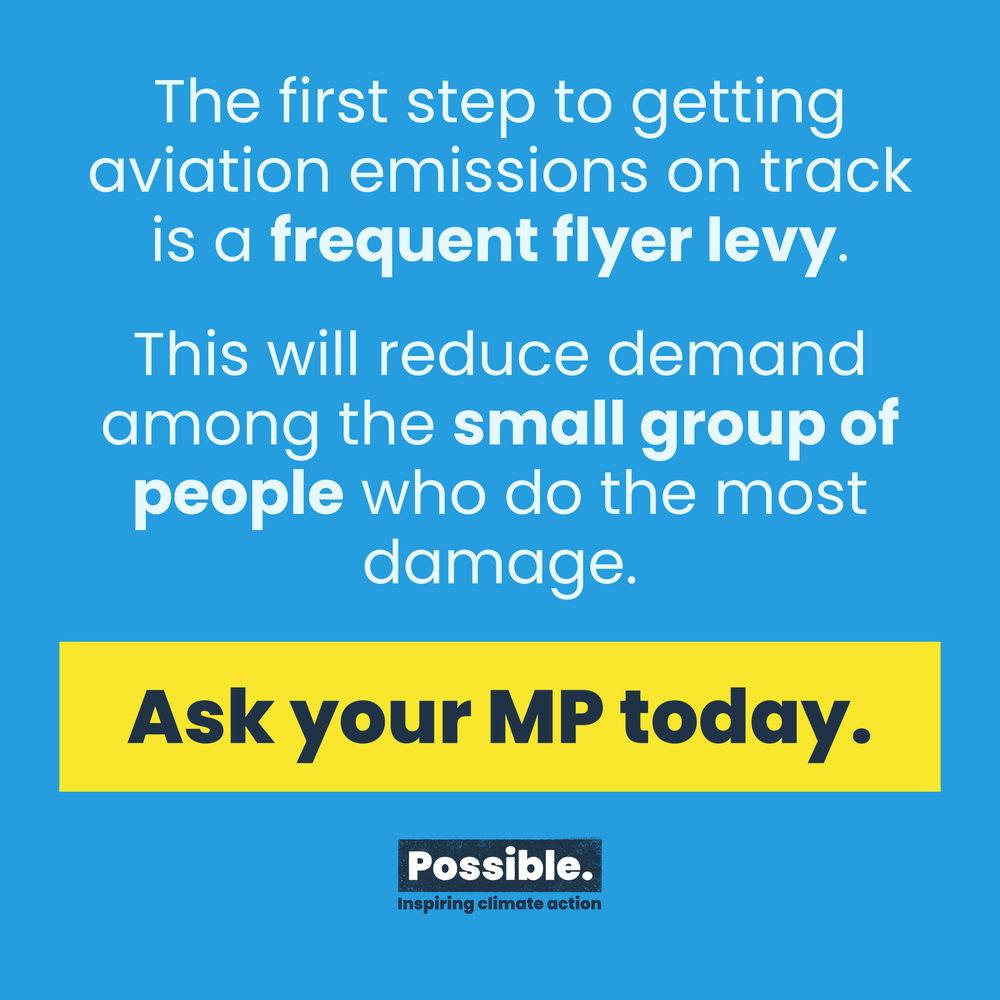
This report shows that the government’s plans to reduce aviation emissions just isn’t’ enough. Without reducing flights, we will not see a sufficient reduction in emissions to meet the government’s own targets, let alone those set out by climate scientists. As such, it calls for more action to reduce flights. By pointing out that it is possible to reach the government’s emissions reduction targets without effecting most people, this report also makes it easier for politicians to support demand reduction measures, such as a frequent flyer levy.