

If aviation wants to have a sustainable future, we need to fly very differently, says aerospace engineer Finlay Asher. With Safe Landing, he and other employees are trying to get the industry and policymakers to truly become more sustainable from the bottom up.
Read the full article (in Dutch) on the “Down to Earth” Magazine (from Friends of the Earth Netherlands) website: https://downtoearthmagazine.nl/uitgesproken-finlay-asher
Translated article below:
Sustainable fuels, aerodynamic aircraft, efficient engines: no matter how innovative the aviation industry develops technologies, if we fly more and more, it will have little effect on the environment. That was the conclusion of Finlay Asher when he worked as an aeronautical engineer at Rolls-Royce plc – one of the largest manufacturers of aircraft engines in the world – on cleaner combustion engines. He quit his job and started Safe Landing. By creating the largest possible community of professionals from the aviation industry, he hopes to secure the future of our planet and the aviation sector.
What is Safe Landing?
“We are an international community of people who work or have worked in the aviation industry and who understand that the current growth of the sector is not sustainable. Some members are aeronautical engineers like me, but there are also pilots, flight attendants, managers and air traffic controllers. What unites us is that we are uncomfortable with the negative impact of flying on the environment, but we also understand the importance of aviation. Flying brings cultures together and lets us experience the beauty of the planet. Furthermore, it is not realistic that aviation will disappear.
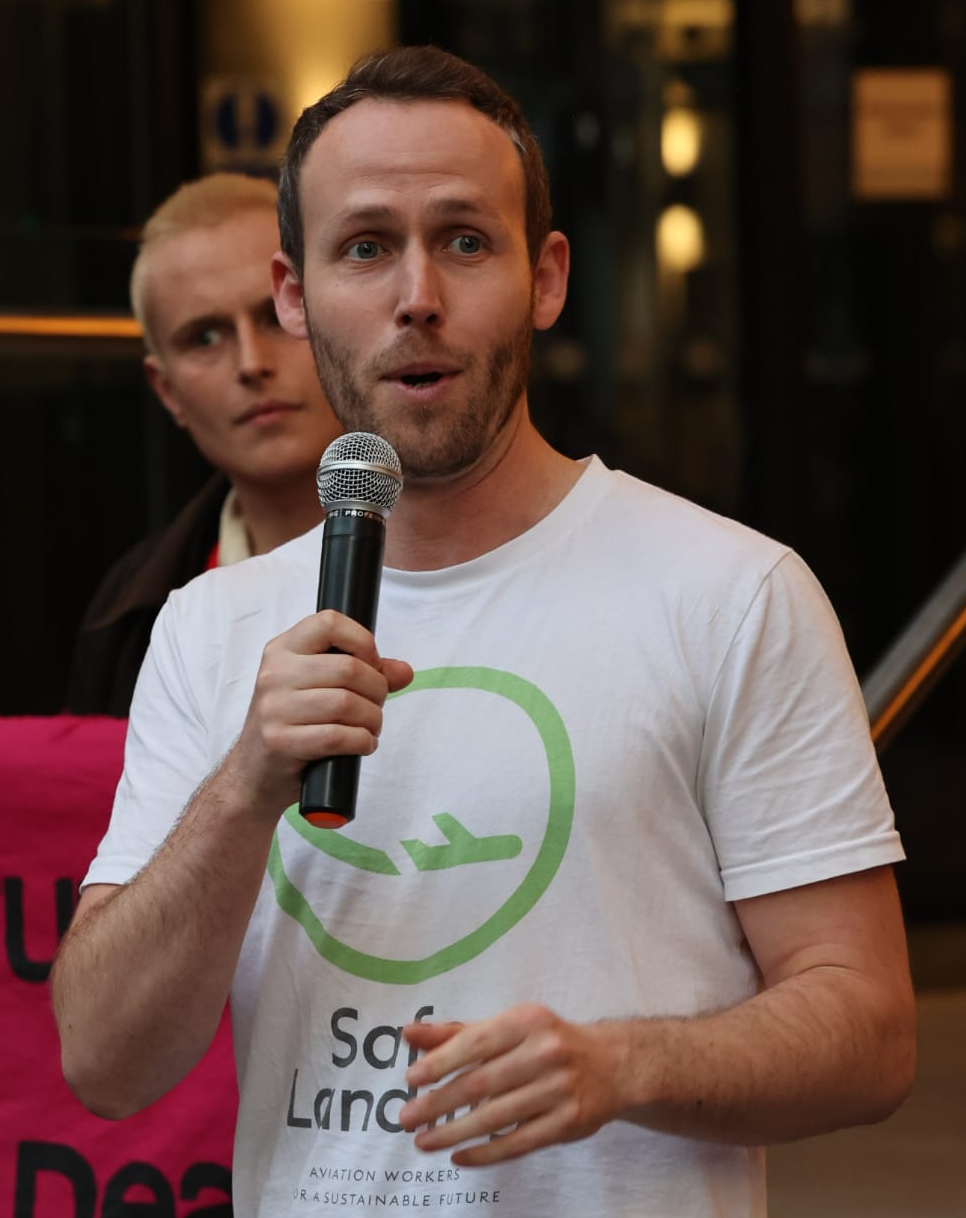
Finlay Asher – aerospace engineer and Safe Landing community member
The only way to save both the climate and aviation is to fly ‘differently’: less frequently, less fast and less far. In doing so, we can also ensure job security for the people who work in the aviation industry. The climate crisis will sooner or later lead to a major crash of the sector, for example because many restrictions are suddenly imposed. The coronavirus (Covid-19) crisis has already shown what happens then. It can cost a huge number of jobs and lead to worse working conditions.”
How does flying ‘differently’ ensure job security?
“Because the right transition can also create new jobs, such as the development of smaller and slower aircraft, electric and hydrogen engines, and the transformation of airports. New jobs are also created in other sectors, such as the energy sector. Sustainable fuels require a lot of renewable energy. What the transition will look like in concrete terms is not yet clear. What is most important is that the transition is fair. This means that employees must be taken seriously and heard, and strategies should not – as is the case now – be purely focused on short-term profit.”
You worked in the sector for many years. Why did you quit your job?
“Because I became increasingly aware of the limitations of technology. When I started this work, I was already concerned about the climate. I knew that flying was polluting, but I thought I could do something about it by working on greater technological efficiency. But that efficiency is being undone by the fact that we are flying more and more. The number of flights doubles every 15 years, while aircraft only become about 10 percent more efficient in that same period. So the net result is only becoming more polluting. The CEOs and policymakers themselves know that, but of course they are not going to acknowledge it. I no longer wanted to be part of this misdirection.”
In other words: technology won’t cut it.
“I am not saying that we should stop working on more sustainable and efficient technology. It’s just that the benefit will be cancelled out if we fly more and more. Moreover, with current innovations we are making only minimal gains per flight. That is also something we advocate: be honest about the limitations of technology and fuels, and acknowledge that much more is needed. Governments also have a role to play in this. We need stricter regulation. For example, if you impose higher taxes on fossil fuels, limit airport capacity or set CO2 budgets, the industry will automatically come up with solutions that really contribute to the climate.”
How do you try to bring about change with Safe Landing?
“We work from the idea of Workers’ Assemblies, democratic consultation bodies. Of course, there are already unions, but they mainly focus on topics such as wage increases or working conditions. We really want a structural and radical change in the industry, focused on sustainability. Much of what we do is focused on bringing people together. For example, we organize group discussions in which members share their concerns and knowledge about developments, and expert talks in which specialists inform us about policy, technology or climate impact. This input is important to properly inform our community, so that we can then make ourselves heard in the public and political debate. For example, we participate in government consultations on the expansion of airports and speak in the media and at events.
In addition, we conduct discussions within the industry. Our bottom-up approach is our strength here. Employees know how the companies and strategies work and can more easily reach people higher up in the organization. They are also more willing to talk to their own employees than to people from outside. But we do not want to create an us-versus-them mentality. There is already enough polarization. We have to shape this transition together, otherwise it will harm us all. Of course, you need people who take more urgent action for change, but we are committed to a nuanced and detailed conversation. That was still missing.”
Does that approach work?
“Success is difficult to measure. An aircraft manufacturer or airline is not going to suddenly change its entire strategy and changes in regulations are also slow. I do see that our community is growing and that the attention for us is growing. That increases our strength. But whether I am optimistic or not, ultimately does not matter. The fact is that this has to happen and that we have to fight for it. No matter how challenging and long the road is. I am not someone who gives up easily.”
Do you see yourself returning to the industry?
“I still consider myself part of the industry.” But to get back to work as an aerospace engineer, the industry first needs to make the right transition. That is also the metaphor of Safe Landing: when problems occur during a flight, the pilot makes an emergency landing. Safety always comes first. Similarly, we need to get aviation’s carbon emissions under control and on a downwards trend. Only when the problem is fixed can we return to the skies, and fly again another day.”