

Background
Like most governments and many other sectors, the aviation industry has an objective of ‘Net Zero emissions by 2050’. However, this will not be enough to meet the goals of the Paris Agreement without ambitious near-term reductions of emissions that we appear unwilling to deliver. See our position on “Net Zero by 2050” here: https://safe-landing.org/icao-net-zero-2050
Instead, our industry is increasingly chooses to justify the continuation of high aviation emissions levels by planning for the use of ‘negative emissions technologies’ or ‘NETs’ in the fairly distant future. However, at Safe Landing, we view this as a dangerous and reckless strategy.
To understand why, read on, and watch our ‘lunch & learn’ recording of our presentation here:
What are NETs?
Negative Emissions Technologies (NETs) can also be called: ‘Carbon Capture & Storage’ (CCS), ‘Carbon Dioxide Removal’ (CDR), ‘Greenhouse Gas Removal’ (GGR) or ‘Engineered Removals’.
NETs refers to industrial processes (rather than natural processes such as tree growth) which actively remove carbon dioxide (CO2) from the atmosphere by capturing and storing it, supposedly permanently.
The technologies usually proposed are:
1️⃣ Direct Air Carbon Capture & Storage (DACCS) – capturing CO2 directly from the atmosphere via industrial processes and storing it underground.
2️⃣ Bioenergy with Carbon Capture & Storage (BECCS) – producing energy from biomass, then storing part of the resulting carbon underground or in the soil.

Why we can’t rely on NETs
Our industry promotes NETs as a solution for “hard to abate” emissions, relying on a scale-up of these technologies to achieve our “net zero by 2050” goal. E.g. watch this marketing video featuring Scot Kirby, the CEO of United Airlines:
However even if we kept this goal (which is very unlikely), it would come far too late.
Keeping global warming below 1.5°C is critical to avoid catastrophic runaway global heating. At present emissions levels, the 1.5°C threshold will be exceeded around 2030:
“Human activity is destabilising the Earth’s climate. A rise in global average temperatures is already having a significant impact on weather systems and society. Climate science tells us that if global average temperatures rise more than 1.5°C above pre-industrial levels, this impact could become catastrophic and potentially irreversible.” – the Coalition for Negative Emissions, June 2021
Above this temperature, climate feedback loops may lead to tipping points being breached which then result in permanent and potentially irreversible impacts such as: loss of Arctic summer sea ice, loss of glaciers, rainforest dieback and the extinction of many species.
NETs won’t be scaled-up before then and may be incapable of lowering global temperatures back to a safe level afterwards.
Therefore, the potential existence of large-scale NETs at some point in the future, should not distract us from actions that rapidly reduce aviation emissions this decade.
NETs are unproven and risky
Our sector is counting on NETs for our decarbonisation plans, and appears confident that this will work:
United Airlines CEO, Scott Kirby: “These game-changing technologies will significantly reduce our emissions and measurably reduce the speed of climate change”. DAC technology, says the airline [United], is one of the few proven ways to physically correct for aircraft emissions and can scale to capture millions, and potentially billions, of tonnes of CO2 per year. – Greenair (2020)
However, there are only a small number of small-scale prototype NETs facilities in operation around the world.
In 2023, the largest DACCS facility – commissioned in Iceland in 2021 – was only capturing 4000 tonnes of CO2 per year (tCO2/year). There will be two large-scale DACCS plants of up to 1 million tCO2/year, each expected to be operating by the mid-2020s. This will be only 0.2% of 2019 global aviation CO2.
NETs processes are yet to be demonstrated at any significant scale and that scale is likely to present a high number of severe technical, economic, humanitarian and environmental risks or issues. For example:
BECCS will require a massive expansion of industrial agriculture or forestry which may:
❌ cause more emissions than it captures;
❌ require huge land areas that aren’t available;
❌ increase the use of polluting fertilisers and pesticides;
❌ lead to land conflicts and global food insecurity.
DACCS will require a massive energy input which may:
❌ divert limited resources of low-carbon electricity away from the more efficient and effective decarbonisation of other sectors (pages 10-11);
❌ prolong our dependence on fossil fuels. For example, a leading developer (Carbon Engineering) plans to burn fossil gas to power their DACCS process;
❌ necessitate incredibly expensive and long-lead time nuclear energy.
Both technologies have a significant risk of CO2 leakages from pipelines and geological storage as well as requiring large amounts of water, with associated problems.
The fanciful scale of “required” carbon removal emerging from the models underpinning governments’ thinking on climate breakdown is breathtaking:
“By the middle of this century many of the models assume as much removal of CO2 from the atmosphere by NETs as is absorbed naturally today by all of the world’s oceans and plants combined.” Despite the climate modelling community’s reliance on NETs, “there are no proven means by which we can remove carbon dioxide at such unprecedented scales” – Dr Glen Peters, a Senior Researcher and NETs specialist.
We’ve even acknowledged this within IATA, a major aviation industry lobby group:
“Carbon capture is still a distant and unproven option.” – the International Air Transport Association (IATA), 2020
NETs are inefficient, so we should minimise their use
The processes used in NETs are highly inefficient, making them energy- and resource-intensive. This is a fundamental issue and is very unlikely to change, even as technology is developed and improved.
The issue stems from the fact that NETs are essentially acting to reverse the fuel combustion process. During combustion, a fuel consisting of concentrated, energy-dense chemicals is burned to produce heat and useful power (e.g. thrust from an aircraft engine), whilst CO2 is emitted as a by-product. These emissions dissipate into the atmosphere, becoming very dispersed and difficult to re-capture (the atmospheric concentration of CO2 is about 421 parts per million).
Therefore, removing large quantities of CO2 from the atmosphere will require filtering very large quantities of air – either industrially (DACCS) or via biomass (BECCS).
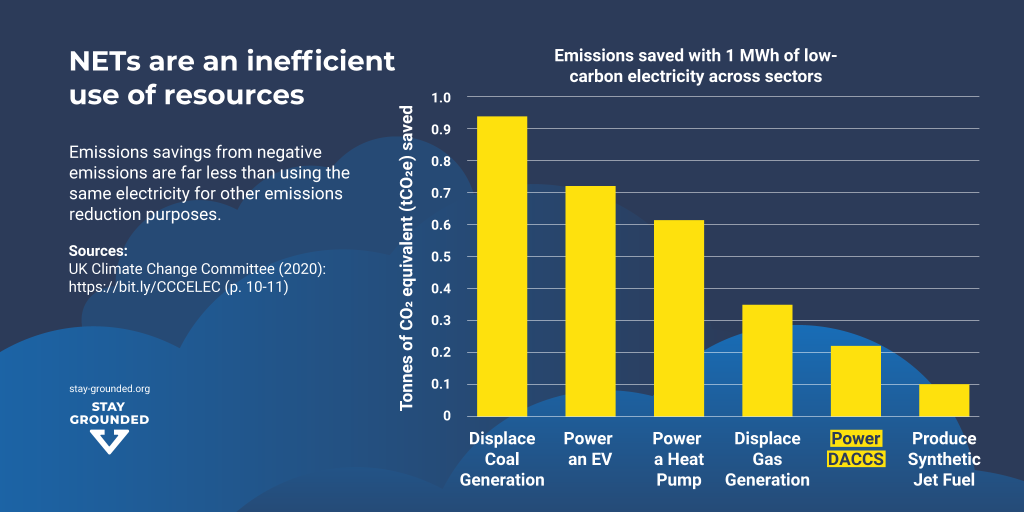
For DACCS we’d need about 30% of the 2022 global renewable electricity supply, or 76 % of all wind and solar energy combined, to provide enough DACCS for aviation at 2019 levels of air traffic. This would divert scarce renewable electricity away from other areas of the economy where it would be better utilised for greater emissions reductions (pages 10-11):
When it comes to BECCS, whether from trees or crops, only a small part of the CO2 emitted is captured (less than 11% at Duiven, Netherlands, the biggest plant in operation in 2021) and less CO2 is removed than by simply stopping deforestation and promoting natural forest restoration.
This makes BECCS particularly inefficient, requiring vast areas of land: we would need 0.8 to 1.4 times the area of India planted with forests to produce enough wood residues to compensate for aviation emissions at 2019 levels of air traffic.
We simply cannot plan for large-scale BECCS and other forms of bioenergy (e.g. aviation biofuels), without huge risk to people and planet.
NETs will remain high cost
The aviation sector argues (page 94) that even though the cost of NETs is high today, it will decrease with time as the technologies are scaled-up.
However, even with optimistic efficiency improvements, they will remain expensive into the future due to the fundamental thermodynamic inefficiencies of the processes.
The scarcity of the supply of resources (e.g. biomass and renewable electricity) required for NETs, versus the high demand and competition across sectors for those same resources, is also very likely to keep the operating costs of NETs very high. The initial capital costs for building NETs facilities are also unlikely to drop very far. Constituent components are already produced off-the-shelf and therefore economies of scale will most probably not produce large benefits.
However, a feature of the aviation industry (particularly at international level) is very low levels of emissions pricing, which are far below that requires to pay for the relatively high cost of NETs:
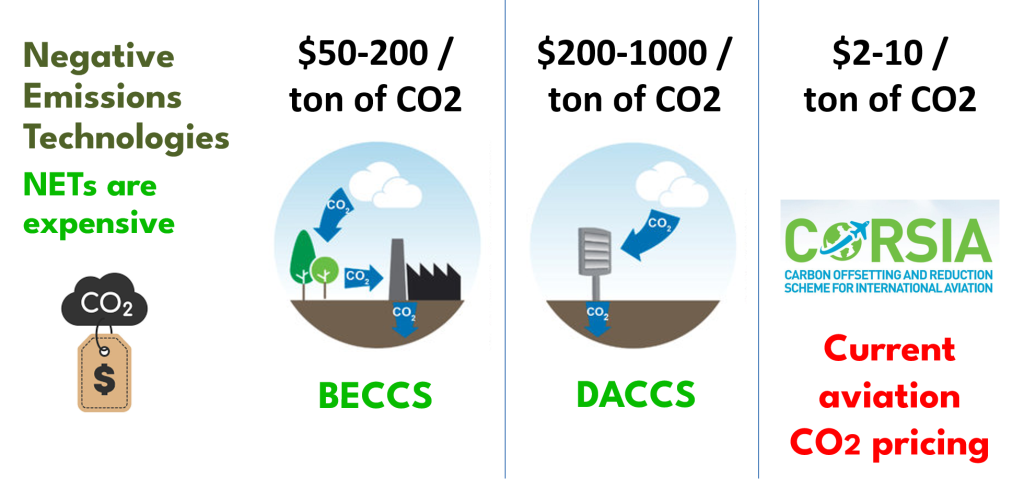
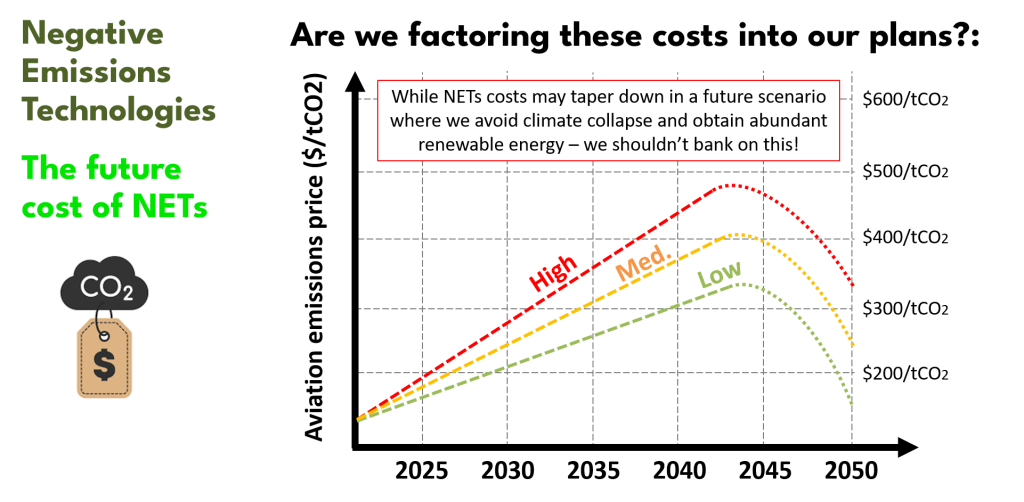
We need to start planning for the economic reality of far higher carbon pricing, and should begin ramping up aviation carbon pricing towards realistic future levels (scenario planning for low, medium and high prices should be included – with a reasonable middle baseline used by regulators to set a carbon pricing roadmap):

We view it as problematic to optimistically assume that the high projected cost of NETs will significantly drop in price with time (particularly if aviation is unwilling to pay the early, high cost of NETs – in order to develop and scale it):
Aviation is the industry which is most likely to be reliant on some fossil fuel in the future, and thus on NETs. The other potential industry is agriculture (due to emissions from e.g. livestock, fertiliser and land use), but this sector has far less capacity to pay a high carbon price – due to the consequential impact on food prices. Other so-called “hard-to-abate” industries such as steel and cement produce products which are relative commodities and will impact construction/building prices. Similarly, applying an extraction tax to fossil fuel producers (although ultimately necessary) will increase costs for every sector as they decarbonise. As such, there is a real need for the aviation sector to raise revenue to pay for scaling-up NETs. Failure to do so, will likely lead to aviation being hit with a sudden jump to inevitably high NETs prices next decade:
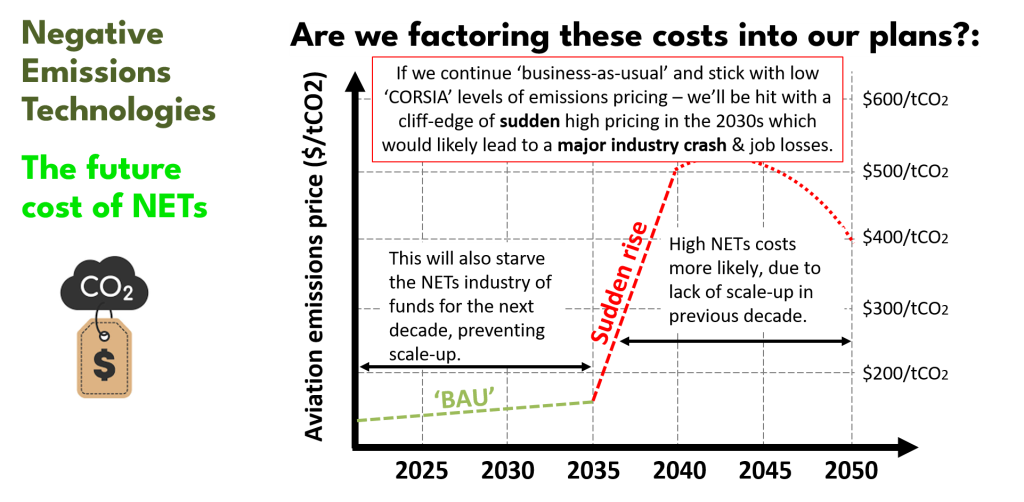
This is why Safe Landing is in favour of higher aviation carbon/emissions pricing. We advocate for this pricing to be ramped up progressively over the next decade via a clear pricing roadmap agreed by governments, in order to smooth the transition to higher pricing, rather than be hit with a cliff-edge of sudden high pricing and an inability to even attempt to use NETs, as the technology remains un-scaled.
A reliance on NETs would be unfair
Our sector argues that it is fair to keep increasing aviation emissions and pay to remove CO2 from the atmosphere later, when and where it is more cost effective.
We even wish for government subsidies for this instead of applying higher taxes, with the argument that flying is important for society and should be kept affordable for those on low-incomes.
In reality, the future promise of NETs provides relatively high-income, high-emitting groups with an apparent “licence to pollute”. It also presents relatively low-income, low-emitting communities with greater exposure to climate risks.
Low-income groups are relatively unlikely to fly (80% of the global population has never flown and 1% of the population are responsible for 50% of aviation emissions) and so don’t actually benefit from the price of aviation being kept artificially cheap by the emissions remaining low priced or unpriced. This is a large economic injustice.
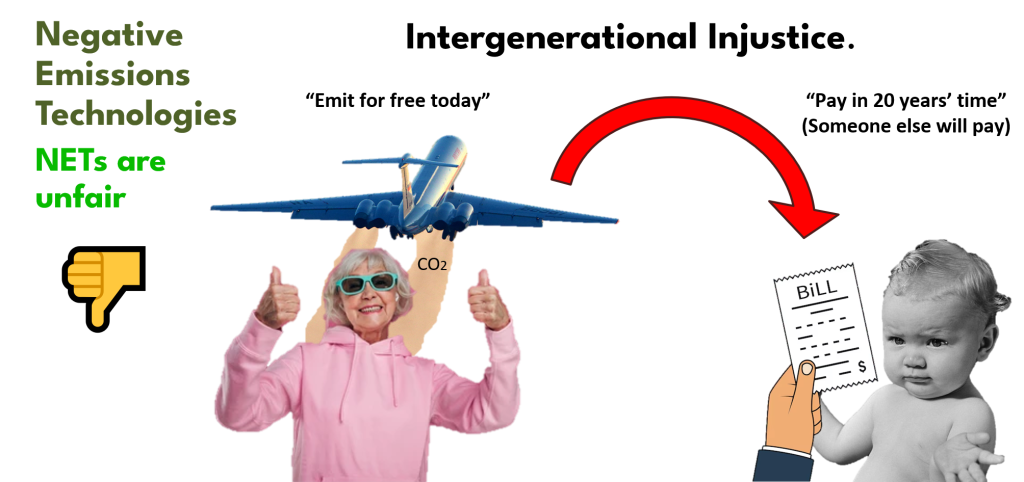
There is also an intergenerational injustice. By emitting now and paying for removal later, future generations would need to remove huge quantities of emissions from the atmosphere, for which they were not responsible. The future costs for this are not being budgeted and it’s probable that future economic growth will be curtailed by increasing frequency and severity of natural disasters and the depletion of natural resources. This will make it more difficult to raise the necessary revenue for NETs in the future. A high proportion of the income of future generations might need to be spent on NETs as climate breakdown bites harder. This would present a huge social injustice, and inter-generational injustice:
Who should pay for NETs?
NETs could be paid for in a variety of ways: via government funding from general tax revenue; from dedicated taxes on aviation (kerosene tax, Frequent Flying Levy…) or from voluntary payments from the aviation sector.
Our sector argues that due to the significant cost of NETs, governments should provide financial support to scale-up the technology, so that aviation growth is not affected.
However, taxpayers subsidising NETs would be an irrational move for a number of reasons:
❌ As discussed above, most people either never fly, or rarely fly, so money raised from their taxes will be used to subsidise the high-emitting activities of a high-income minority.
❌ Subsidies for NETs risk wasting public money on an expensive solution and would keep flying artificially cheap, resulting in more air traffic and emissions, than if the airlines/travellers paid for NETs themselves.
❌ This taxpayer money would incentivise continued extraction and emitting of carbon for as long as possible. The fact that the Oil & Gas industry is mostly benefiting from government contracts and spending on NETs, gives them a perverse incentive to maximise pollution today, in order to maximise the size of the removal market tomorrow. This is like awarding window-repair contracts to the same vandals who are walking around the city at night smashing all the windows.
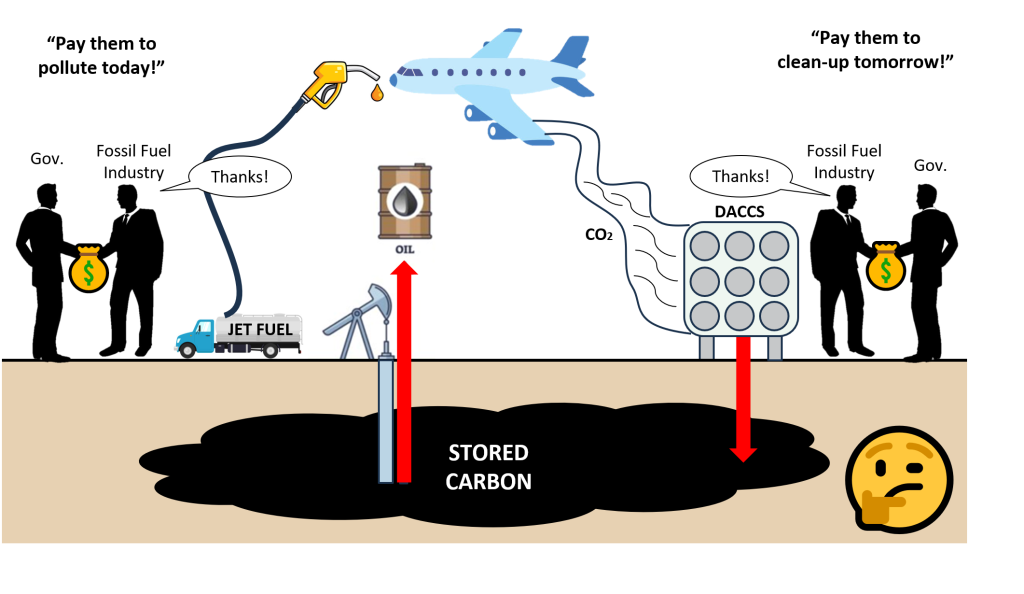
❌ Subsidising NETs could also make large new CO2 volumes available and affordable that would allow the Oil & Gas industry to use a process called ‘Enhanced Oil/Gas Recovery’ to extract even greater quantities of oil and gas from declining fields that would have otherwise remained underground.
Who should benefit from NETs?
Many existing and proposed NETs projects:
🌐 Are located in the Global North.
🌐 Will provide economic benefit / jobs to nearby communities there.
🌐 Feature contracts awarded to major energy companies, also headquartered in the Global North.
… so the countries and companies most responsible for global emissions (and for aviation emissions) are the one who will most benefit from the clean-up operation.
However:
🌎 Countries in the Global South are the most exposed to near-term climate impacts.
🌎 Their communities are most in need of economic diversification away from fossil fuels (and tourism).
🌎 They tend to be located close to the equator, in areas with high renewable energy capacity and with hot & humid climates which make DACCS most cost/energy efficient.
… so, shouldn’t the people least responsible and most impacted by global emissions (and aviation emissions) be the ones who should benefit from the clean-up operation?
Summary
Our Safe Landing positions:
1️⃣ NETs are unreliable: they will be unable to reverse climate change. We must also prepare for the worst, and assume they won’t work, rather than hoping for the best.
2️⃣ NETs are unproven and risky: the evidence suggests that large scale NETs deployment might cause more harm than good.
3️⃣ NETs are inefficient: this is a fundamental issue and there are limits to improvement. Limited low-carbon energy will be better used elsewhere.
4️⃣ NETs are expensive: this is unavoidable due to their high energy-intensity.
5️⃣ NETs are unfair: relying on them is a recipe for large socio-economic and inter-generational injustices.
6️⃣ NETs will need to be paid for: ideally by the fossil fuel industry, and the high costs factored-in to the business models of aviation companies.
Caveats to these positions:
1️⃣ While NETs should not be relied upon to reduce emissions in the future, we probably should still develop them in order to:
- Have them available so that we can attempt to reduce the harm caused by excess CO2 already in the atmosphere.
- Understand the best CO2 capture efficiency possible.
- Better understand the risks associated with various NETs.
2️⃣ While NETs are inefficient and offer lower carbon abatement per unit of renewable energy / biomass than other uses:
- It makes sense to locate NETs geographically where there is a relative abundance of renewable energy supply and relative lack of energy demand. E.g., in a desert where there’s lot of solar, or far out to sea for offshore wind.
- However, even in these locations, NETs only make sense if located close to a suitable carbon storage reservoir. They also need to compete vs. Green H2 production at those locations for e.g. green fertiliser, green steel, etc to displace fossil fuel use.
The positive story for aviation
✅ A focus on policies that target fossil jet fuel can drive down CO2 emissions: keeping our planet habitable, tourist destinations visitable, and ensure that an aviation sector continues to exist.
✅ The higher fuel/emissions pricing required to eventually pay for NETs will incentivise aviation companies to innovate: drive aircraft technology development and create more aviation jobs.
✅ We could use some of the fuel/emissions price revenue to pay loss & damage funds to the most climate-vulnerable countries.
✅ By making ‘polluters pay’ and directing those funds to these areas: we can address, rather than perpetuate, climate injustices.
Conclusion
Our industry, supported by fossil fuel companies, are advocating for NETs and carbon offsetting, to prolong business-as-usual and hence dependence on fossil fuels.
Such schemes could provide an apparent ‘license to pollute’ , while dangerously claiming that unproven and inefficient NETs like BECCS and DACCS will one day balance out all the carbon emitted across previous decades. In essence, we’re trying to bury out heads in the sand.
This undermines actions for real deep emissions cuts and could be used as an excuse to justify new oil and gas infrastructure, locking us into decades of continued fossil fuel use and potentially causing us to miss a pivotal, short window for radical change.
The development of NETs cannot serve as a substitute for deep emissions reductions now.
Every tonne of carbon promised to be removed by NETs in the future, represents emissions that are bringing us closer to climate catastrophe today.
“Negative emission technologies are not an insurance policy. They are a high risk gamble with tomorrow’s generations, particularly those living in poor and climatically vulnerable communities, set to pay the price if our high stakes bet fails to deliver as promised.” – Professor Kevin Anderson