

At Safe Landing, our members are firmly of the position that there needs to be a rapid reduction in private jet use, and we need our leaders to enact the necessary policies to achieve this.
Private jets have become synonymous with luxury and exclusivity, enabling rapid and convenient travel for the affluent. However, it is essential to recognize that private aviation significantly contributes to climate change due to its high carbon emissions. This blog post aims to provide a high-level overview of why private jets are particularly detrimental to the climate, shedding light on the key factors driving their environmental impact, and what we can do about it.
Fuel Efficiency and Emissions
Flying in a private jet is essentially the most inefficient and most carbon-intensive mode of transport. They are 10x more carbon intensive than a normal airliner and 50x worse than trains. A four-hour private flight emits as much as the average person does in a year.
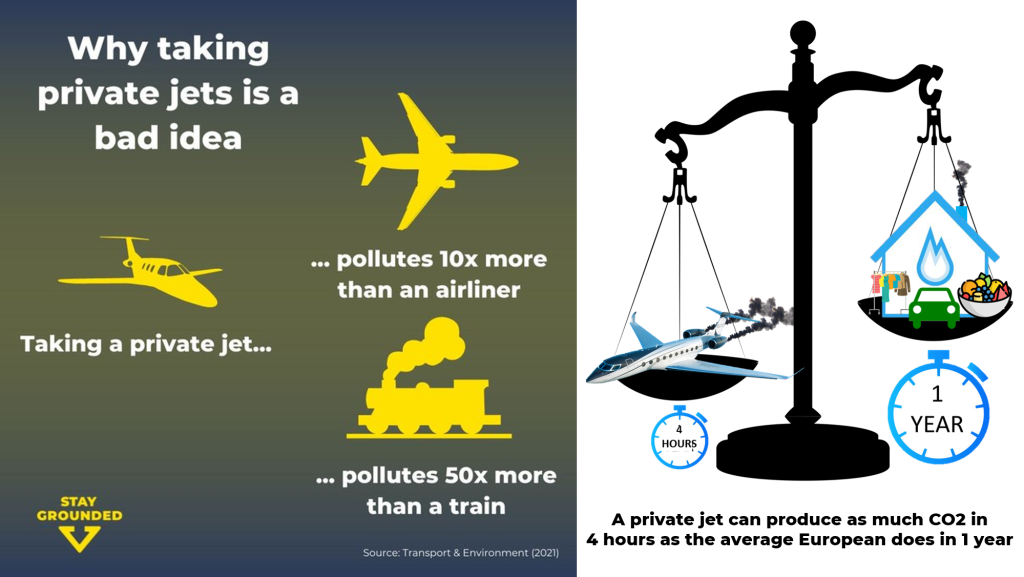
Putting private jet pollution into context
Speed and Space
The reason for this is partly because private jets are designed for speed rather than minimum fuel burn. They also tend to fly only a few passengers at a time, compared to commercial airliners which are usually filled close to capacity with passengers. In addition, the interiors of private jets tend to be luxurious, rather than economical and weight-saving, which also increases fuel burn per passenger-mile flown.
Route Efficiency
In combination with these factors, private jet users also tend to fly relatively inefficient routes. Often they will fly very short distances where ground transport options were readily available. Flying is particularly inefficient at very short distances. This is because the aircraft spends a significant proportion of the flight in take-off and climb, rather than at high-altitude cruise.

The Guardian – The most popular routes for private jet flights in Europe.
Inequality and Environmental Justice
The climate impact of private jets also raises concerns about social and environmental justice. The luxury and exclusivity associated with private aviation reinforce socio-economic disparities, as the privileged few continue to contribute significantly to climate change while a majority of the population bears the consequences – many in the Global South.
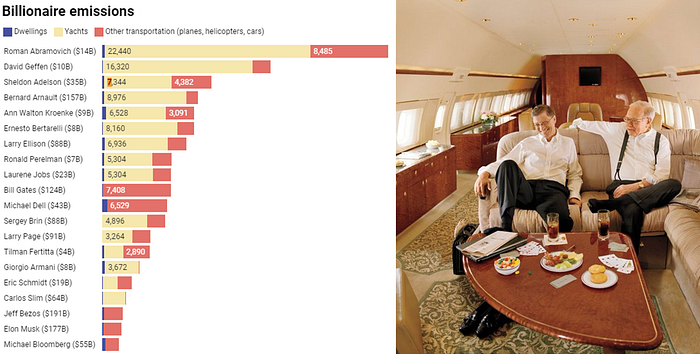
Figure from The Conversation: it can be seen that Bill Gates’ carbon footprint is 7408 tonnes of CO2 per year. This is 3500 times higher than the global per capita emissions target of 2.1 tCO2/year required by 2030 to keep global warming below 1.5°C (UNEP, page 25).
A surge in the the ultra-wealthy flying in private jets appears to send the wrong message on equity and fairness. This is the principle that high-income high-emitters should take the most rapid climate action by cutting their emissions earlier and faster. This a principle that all nations have signed up to under the 2015 Paris Agreement. It’s also essentially a mathematical necessity if we are to have any hope of cutting global emissions in the time required (we need to halve emissions by 2030):
The Fastest Way to Blow our Limited Carbon Budget
A big issue with private jets is that in a world where we have a limited carbon budget, this budget is being blown on a very small number of very rich individuals, rather than benefiting much larger numbers of lower-income travellers if we instead prioritised travel using more efficient modes of transport.

This explains why the International Transport Workers’ Federation (ITF), in their 2022 report “A Zero-Carbon Future for the Aviation Sector“, propose:
“The use of private jets must be severely curbed through new taxes now, followed by flight restrictions for any carbon-emitting private flights after 2030.” (Page 24)
Incentives that decrease or remove the least useful functions of aviation should also be introduced. Such policies should include bans on private jets […] Private jets deserve special attention from global policy makers. Private jet flights have a much higher carbon footprint than commercial planes, which is compounded by significant growth in the sector, as the rate of growth in private jet flights outstrips that of commercial flights. To ensure that the private jet industry is sustainable, from 2030 onwards, only zero-carbon private flights (such as battery powered flights) should be allowed. Before 2030, additional taxes should be raised on private flights, with the exception of private flights that have a social or safety maintenance purpose (such as essential medical supplies). Private flights should also be included in CORSIA (from which they are currently excluded). (Page 19)
What should we do?
We can enact policies which can reduce the use of fossil fuels in aviation, and will therefore minimise the immediate impacts of climate change on the most vulnerable people and areas. This will also give us the best chance of reducing the risk of dangerous runaway global warming and climate breakdown, which will ultimately affect all of us.
These can involve imposed limits on aircraft/airline/airport use. They can also include financial measures like taxes/levies that can also simultaneously raise funds which could be used to pay for climate action e.g. climate loss and damage or adaptation funds for the most climate-vulnerable countries, investment in renewable electricity, public transport or home insulation etc.
Ban Private Jets
An outright ban on private jets would instantly cut the most carbon intensive way of travelling and prove governments are serious about effective climate action. Our group, Safe Landing, performed a poll on twitter and 39% of 130 participants voted it as the most important policy governments should enact.
Without an outright ban, another option is a ‘ticket and fuel tax’ for fossil-fuel private jets, in the realm of €3000 as Switzerland has in place. Transport and Environment claims this would raise “several hundreds of million euros, which should be ring fenced to help fund the development of the new aviation technologies”.
Tax Jet Fuel
There is currently a 0% tax rate on kerosene (the primary fuel for aviation) while there is nearly a 50% tax on petrol and diesel for public consumption in transport such as cars and buses. We need to get serious and tax jet fuel.
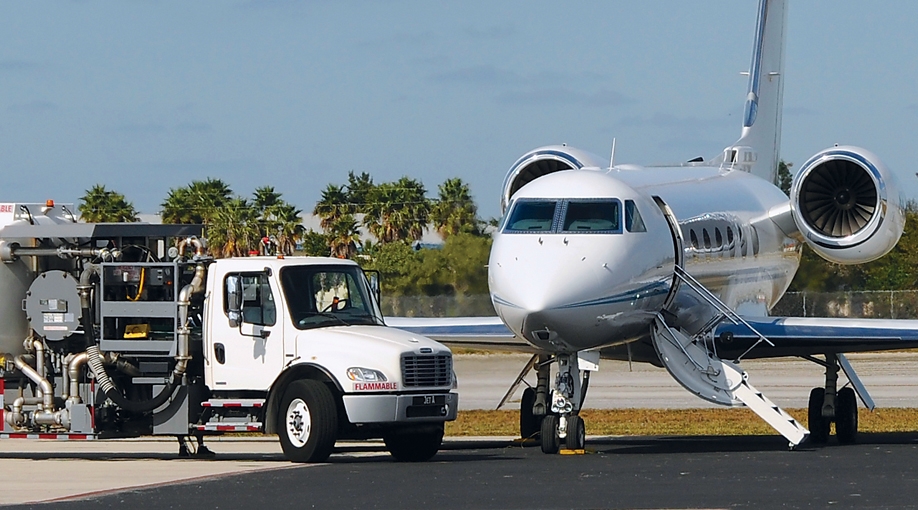
At the heart of this policy is the fundamental issue of fairness. We’re amidst a cost-of-living and climate crisis, where many are struggling to pay bills due to the rising cost of fossil fuels. There is also, for instance, controversy over additional environmental charges for polluting cars in low emissions zones in many cities. People on low-incomes will understandably feel bitter about the situation, if a billionaire can fly into London in their private jet and fill up their tank tax free.
In the UK, if taxed at the same rate as the fuel duty on petrol and diesel paid by motorists, this would raise in excess of £10bn a year that could be spent on climate finance and on green jobs e.g. renewable energy, insulating homes, installing heat pumps, electric vehicle charge points, improving public transport, or social care.
Frequent Flyer Levy
Introduce a frequent fly levy to ensure the increased financial burden is mostly shouldered by regular, high-emitters with a large number of air miles.

It is predominantly high-income, high emitting groups who are frequent flyers, yet it is predominantly low-income, low emitters who bear the brunt of the health and climate impacts from aviation emissions.
If we more fairly taxed the minority of the population who fly the most — the higher taxation would discourage their use of fossil fuels and ensure that it is mostly wealthier groups who pay for climate finance.
Reform or Ban Frequent Flyer Programmes
Additionally, we could ban airline ‘frequent flyer programmes’ which subsidise frequent flyers (at the expense of everybody else, and the climate). These programmes essentially act as “Reverse Robin Hood Schemes” with wealthy customers purchasing goods from retailers using credit cards which charge a premium for financial transactions. The result is increased store overheads, with the associated costs passed on to all consumers through rising product prices — whilst the credit card users are ‘rewarded’ for this via the allure of ‘free’ air miles.
Summary
A vast emissions inequality exists in the world today, and this inequality even exists internally within some of the wealthiest countries. Nowhere is this more true, than in the income profile of frequent flyers. The sky-high wealth and sky-high aviation emissions of private jet users is the absolute pinnacle of this emissions inequality.

If we are to have any social ‘licence to operate’ within the aviation sector we need to address and face up to difficult facts like this. With a growing cost-of-living crisis sweeping the world, and a climate emergency that is worsening with each year — is it consistent that private jet sales are soaring and billionaires can fill them up with jet fuel tax free? What sort of message does this send?
At Safe Landing, we feel convinced that if we find ourselves incapable of banning or cutting private jet use considerably — then as an absolute minimum the sale and use of private jets should be taxed at a much higher rate to help fund climate finance for the most vulnerable areas and people. Banning private jets, and higher rates of tax for frequent flyers and those that fly further have been key recommendations for the aviation sector provided by numerous Citizens’ Assemblies on climate change, including in the UK, Scotland and France:
If you’re an aviation workers and the issues and approach to this problem resonates with you, please join us at Safe Landing to continue the conversation and to take action!: https://safe-landing.org/