
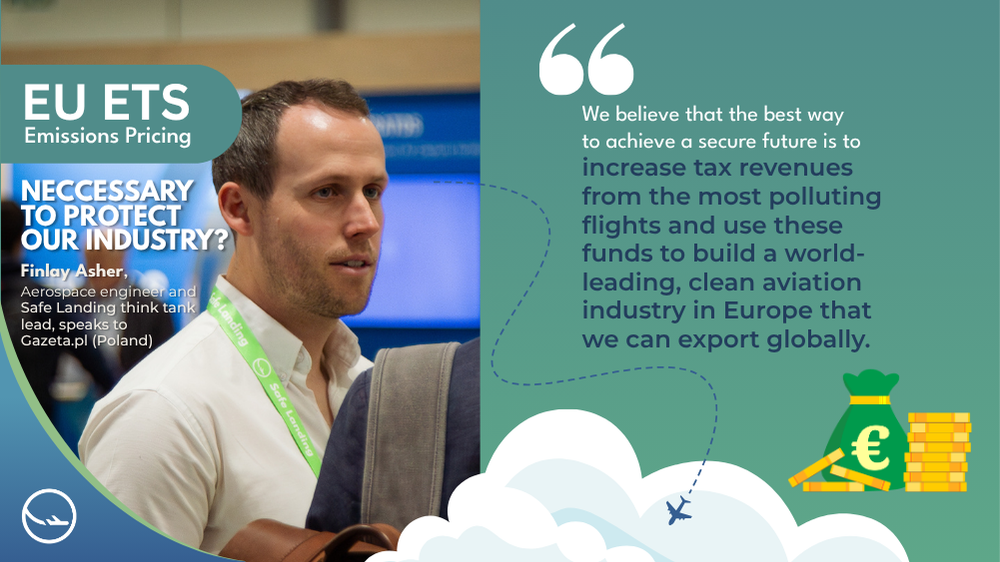
In a recent interview with Polish media outlet Gazeta.pl, Safe Landing co-founder and aerospace engineer Finlay Asher argues that the aviation industry faces a clear choice: continue defending a fossil fuel-dependent growth model, or invest now in a fair transition towards clean air travel.
Read the article here: https://next.gazeta.pl/next/7,172392,32800870,banka-w-branzy-lotniczej-peknie-koszty-latania-sa-sztucznie.html
Speaking from the perspective of aviation workers, Finlay explained that Safe Landing’s goal is to ensure aviation can survive the climate crisis while protecting jobs and creating a resilient future for workers across the sector. He makes the case that stronger climate regulation – including expanding the EU Emissions Trading System (ETS) to cover long-haul international flights – should be seen not as a threat, but rather as an opportunity to fund the transition away from fossil fuels.
The interview highlights aviation’s current vulnerability to oil price shocks, geopolitical instability, health pandemics, and climate disruption. Rather than reducing aviation taxes and weakening environmental policies, Finlay argues that Europe should use carbon pricing revenues to build a world-leading clean aviation industry, investing in zero-carbon and hybrid-powered aircraft technologies and creating highly-skilled jobs designing, testing, manufacturing and operating the aircraft.
Finlay also warns that Europe risks repeating the mistakes made in the electric vehicle (EV) and renewable energy sectors, where industrial leadership shifted elsewhere after years of underinvestment. He points to emerging European aerospace innovators (Aura-Aero, Beyond Aerospace, Dovetail, Electron, Elysian, Evolito, NRG2Fly, Noemi, Vaeridion, Zeroavia etc.) as evidence that a different future is possible – but only if governments use innovative policies to create clear market incentives and sustained public investment.
That public investment requires increased pricing of the most polluting flights in order to fund it.
A major theme of the interview is that climate change is not an abstract environmental issue for aviation workers – it’s already disrupting the industry itself. Increasing turbulence, extreme heat, flooding, wildfires, and rising sea levels are directly affecting both aircraft operations and airport infrastructure around the world.
The piece also challenges the narrative that climate policy is what makes flying expensive. Finlay notes that fossil fuel volatility and geopolitical crises already increase ticket prices far more than existing EU climate charges do. Meanwhile, aviation continues to benefit from artificially low costs and under-taxation despite plans for massive expansion over the coming decades.
Rather than pursuing unlimited growth in conventional aviation, Safe Landing calls for a smarter model of development: using revenues from today’s fossil fuel-powered aviation system to finance smaller-scale zero-carbon and hybrid-powered aircraft. This can create improved regional connectivity, cleaner jobs, and quieter, healthier communities around airports.
The central message throughout the interview is that aviation workers should not be excluded from climate conversations. Instead, workers have a crucial role to play in shaping a fair, democratic, and sustainable future for flight. Even though many of our industry lobby groups (ATAG, IATA, A4A, A4E we’re looking at you!) argue for short-sighted tax cuts – it’s important that workers, who have the most at stake in the long-term sustainable future of our industry, think for ourselves and challenge this position.