
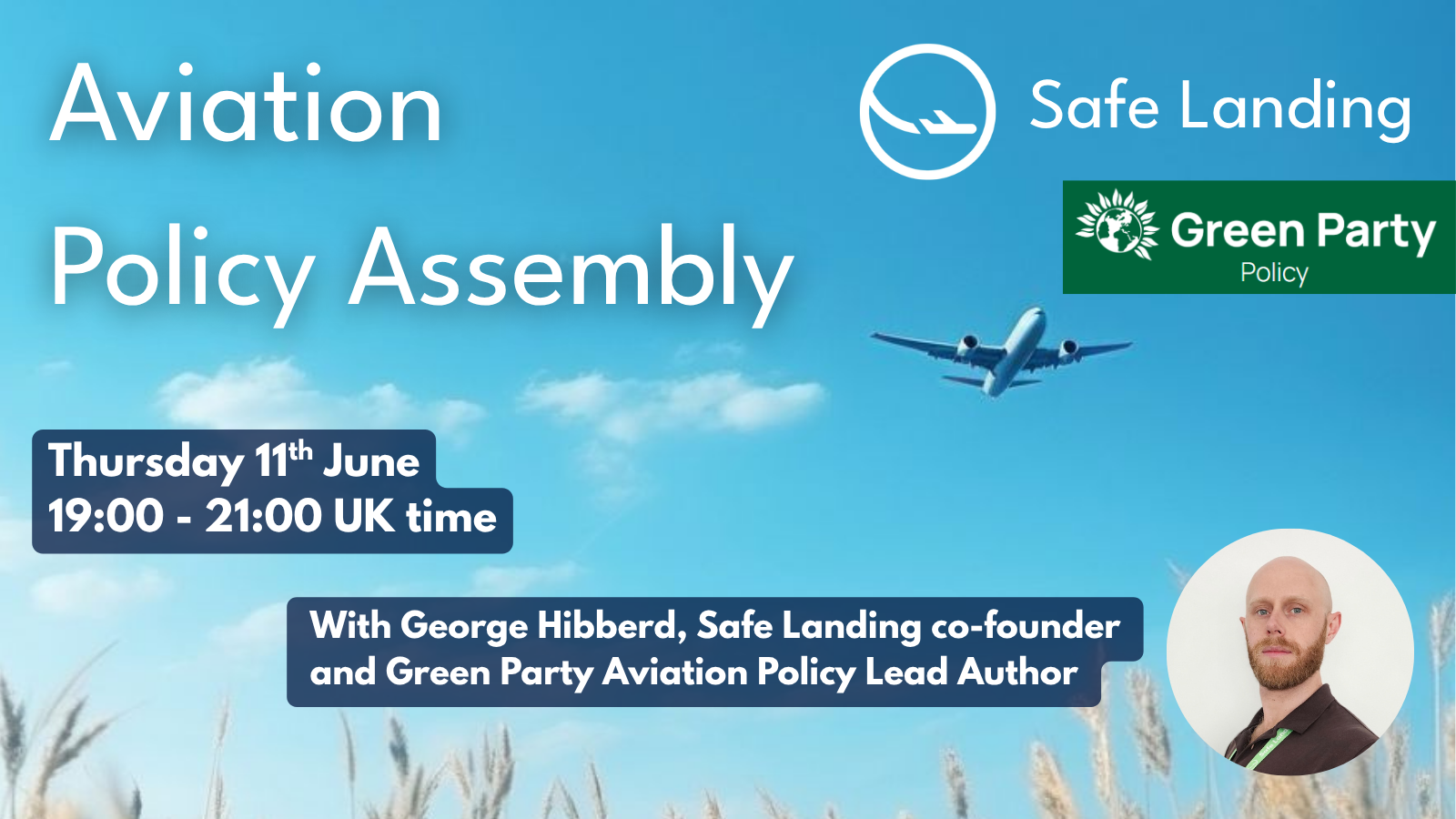
On Thursday 11th June, Safe Landing held a mini-assembly discussing the Green Party of England and Wales’ proposed new aviation policy. Presenting the policy proposals was the policy’s lead author and Safe Landing Workers’ Participation Lead George Hibberd.
George has been leading a small team of authors writing this policy over the last few months with the aim to take these policy proposals to the Green Party’s autumn conference in October 2026. The policy is at the stage where it has gone to external consultation.
The Green Party is very keen to hear our thoughts as aviation workers and enthusiasts on their new bold policy proposals. This was our community’s chance to impact a prominent political party rapidly rising in the polls on the back of a policy agenda based around wealth redistribution and decarbonisation.
We discussed policies such as strengthening the UK Emissions Trading Scheme, fuel taxation, a frequent flyer levy, workers assemblies and contrail avoidance and mitigation.
The policies
Green Party aviation policy proposals
Green Party aviation policy background paper
George’s presentation slides
The results
After the presentation from George, discussion was held in four breakout rooms. The summary of the discussions in each is below:
Carbon targets, Demand management and taxation
There was general support for the demand management and taxation policy. There was some concern that the issue is not necessarily the number of flights taken by frequent flyers but the distance flown. A policy to address the distance was suggested, alongside a suggestion for a ticket levy with a rebate for the first two flights taken.
There was concern expressed that airport expansion was leading to more flights and emissions rather than alleviating airspace congestion.
There was concern expressed about the implementation of a frequent flyer levy, in particular the necessary data sharing required. These was concern about the UK moving alone on demand management and inadvertently moving the problem to another country. Despite this, there was general support for the frequent flyer levy and that the tax revenue could be used to subsidise ground transport and future low carbon flight technology.
Alternative fuels, Alternative and future travel
There was general support for the cautious SAF policies expressed. There was some concern that future technology subsidies would go to the usual large companies and smaller, more innovative companies would be left out. There was support for investment in hybrid electric, but not hydrogen.
There was concern about the energy intensity of Sustainable Aviation Fuels. There were unanswered questions about Chinese electric aircraft.
Overall, attendees supported the policies around SAF and future technology and travel, particularly that the Green Party is skeptical about the ability of future technology to decarbonise aviation without large investment and demand management in the short -term.
Contrails and non-CO2, Air quality & noise, Surface access and Accessibility, Global negotiation and policy
On contrails, there was support for a monitoring, recording and verification (MRV) scheme and large-scale contrail avoidance trials. There was disagreement on the impact of contrail heating but agreement that they were having a substantial effect. There was skepticism about the implementation of tactical contrail avoidance but support for pre-tactical avoidance through reducing night flights. There was concern that the focus on non-CO2 and contrails could distract from the need to decarbonise and that more research is needed. There was support for incorporating non-CO2 impacts into existing climate targets. It was raised that a legal study conducted by Cornerstone Barristers last year, commissioned by NGOs Opportunity Green and Transport & Environment, found that the UK is legally bound under international law to start taking action on contrails immediately, even before the findings of the EU’s MRV scheme are published.
On surface access and accessibility, there was support for the policies but that a balance may need to be struck between “forcing” airports to have better active travel plans versus “encouraging” them. There was consensus that the Greens are on the right track talking to disability access groups.
On global negotiation and policy, there was support for the policies but concern raised that the UK moving on its own may cause passengers to fly elsewhere and not actually reduce emissions.
Civic and worker engagement, Private jets and offsets
On private jets, there was support for their phasing out but concern about the vagueness of the use of the word “expeditiously”. There was concern that unless private jet policy is international then private jets will just move somewhere else.
On worker engagement, there was support for the policies but concern about how to protect UK workers from companies moving their manufacturing to countries where it is cheaper and easier to exploit their workforce.
Presentation Recording
Next steps for the policies
This feedback will now be considered by the Green Party’s transport policy working group. The policies will then move to the pre-conference process internally within the party. The policies will eventually be proposed at the autumn conference and voted on.
We want to thank everyone who attended the policy assembly for their insightful thoughts and we relished the discussions had. It really proved how important it is to engage aviation workers in policy making. We hope to engage with other political parties on their aviation policy creation in the future.
Note: as an organisation, Safe Landing is non-party political and we do not support any particular party over another. We will bring these policy proposals, developed with our Safe Landing community, to any political party in the UK, or elsewhere, who is interested in engaging with us.